The probiotic market is flooded with products making sweeping health claims, but the science behind individual strains varies enormously. Some strains have dozens of rigorous human clinical trials behind them; others have little more than petri-dish data. This guide cuts through the noise and examines only strains with meaningful evidence from randomized controlled trials in humans. Where the evidence is weak or mixed, we say so.
One critical principle: probiotic benefits are strain-specific. Lactobacillus rhamnosus GG and Lactobacillus rhamnosus HN001 are different strains with different evidence profiles. A product listing only species-level names without strain designations is a red flag.
Top Probiotic Strains Ranked by Evidence
Not all probiotic strains are created equal. Below is a summary of the strains with the strongest human clinical trial data, organized by the conditions they have been most rigorously studied for.
| Strain | Primary Evidence | Strength of Evidence | Typical Trial Dose |
|---|---|---|---|
| Lactobacillus rhamnosus GG | Antibiotic-associated diarrhea, acute diarrhea | Strong (multiple meta-analyses) | 10–20 billion CFU/day |
| Saccharomyces boulardii CNCM I-745 | Antibiotic-associated diarrhea, C. difficile prevention | Strong (multiple meta-analyses) | 250–500 mg twice daily |
| Bifidobacterium longum 35624 | Irritable bowel syndrome (all subtypes) | Moderate (multiple RCTs) | 1 billion CFU/day |
| Lactobacillus plantarum 299v | IBS (abdominal pain, bloating) | Moderate (mixed results across trials) | 10 billion CFU/day |
| Lactobacillus acidophilus NCFM | Functional abdominal pain, bloating | Moderate (limited RCTs) | 10 billion CFU/day |
| Lactobacillus reuteri DSM 17938 | Infantile colic, functional abdominal pain | Moderate (mostly pediatric data) | 0.1–0.2 billion CFU/day |
| Bifidobacterium animalis subsp. lactis HN019 | Constipation, gut transit time | Preliminary (mixed results in recent trials) | 1–17 billion CFU/day |
A few things to note: “strong evidence” here means multiple well-designed randomized controlled trials and at least one meta-analysis. “Moderate” means positive findings from individual RCTs that still need replication or have produced mixed results. “Preliminary” means early positive signals that have not consistently held up in larger or more recent trials.

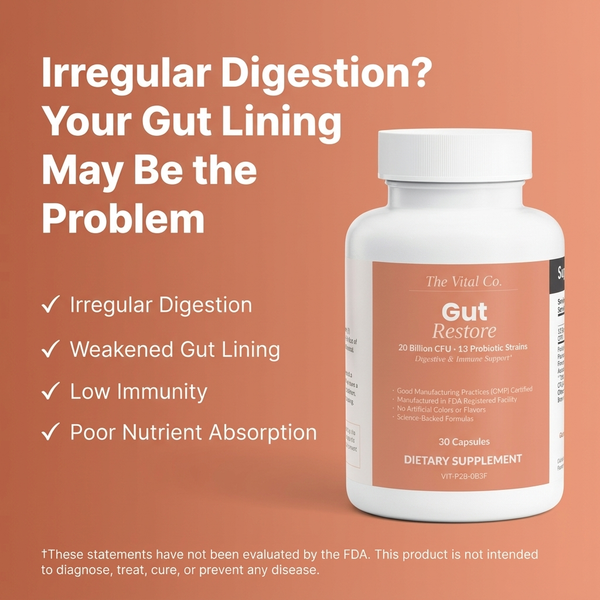
13-strain probiotic complex, 20 billion CFU per capsule. Made in the USA from globally sourced ingredients.
Shop Now — $19.95 →
Frequently Asked Questions
What is the single best probiotic strain?
There is no single “best” strain — it depends on what you are trying to address. For antibiotic-associated diarrhea, L. rhamnosus GG and S. boulardii have the strongest evidence. For IBS, B. longum 35624 has the most consistent data. The best probiotic strain is the one with clinical evidence matching your specific health concern.
Are multi-strain probiotics better than single-strain?
Not necessarily. The evidence does not consistently show that multi-strain formulations outperform single strains. What matters more is whether the specific strains included have clinical evidence for your condition of interest, and whether they are present at clinically relevant doses.
How long should I take a probiotic before expecting results?
Most clinical trials run for 4 to 8 weeks, and this is a reasonable window to evaluate whether a probiotic is working for you. Some trials have shown benefits as early as 2 weeks, while others required the full study duration. If you see no benefit after 8 weeks, the strain may not be effective for your particular situation.
Can I take probiotics with antibiotics?
Yes — in fact, this is one of the best-supported uses for probiotics. Meta-analyses support starting probiotics at the same time as antibiotics to reduce the risk of diarrhea.[10] Space the probiotic dose at least 2 hours from the antibiotic dose. S. boulardii is a particularly practical choice here because, as a yeast, it is not killed by antibacterial antibiotics.[13]
Do probiotics colonize the gut permanently?
Generally, no. Most probiotic strains pass through the digestive tract and are detectable in stool during supplementation but decline after you stop taking them. This is why many researchers describe probiotics as transient modulators of the gut environment rather than permanent residents. Continued use is typically necessary to maintain benefits.
Are there people who should not take probiotics?
Probiotics are generally safe for healthy individuals, but caution is warranted for people who are severely immunocompromised, critically ill, have central venous catheters, or have short bowel syndrome. In these populations, rare cases of probiotic-related bacteremia or fungemia have been reported. Always consult a healthcare provider if you have a serious underlying health condition.
References
- McFarland LV. Systematic Review and Meta-Analysis of Saccharomyces boulardii in Adult Patients. World Journal of Gastroenterology. 2010;16(18):2202-2222. doi:10.3748/wjg.v16.i18.2202
- Szajewska H, Kolodziej M. Systematic Review with Meta-Analysis: Saccharomyces boulardii in the Prevention of Antibiotic-Associated Diarrhoea. Alimentary Pharmacology & Therapeutics. 2015;42(7):793-801. doi:10.1111/apt.13344
- Ducrotté P, Sawant P, Jayanthi V. Clinical Trial: Lactobacillus plantarum 299v Improves Symptoms of Irritable Bowel Syndrome. World Journal of Gastroenterology. 2012;18(30):4012-4018. doi:10.3748/wjg.v18.i30.4012
- Magro DO, de Oliveira LMR, Bernasconi I, et al. Effect of Yogurt Containing Polydextrose, Lactobacillus acidophilus NCFM and Bifidobacterium lactis HN019. Nutrition Journal. 2014;13:75. doi:10.1186/1475-2891-13-75
- Majeed M, Nagabhushanam K, Natarajan S, et al. Lactobacillus acidophilus DDS-1 and Bifidobacterium lactis UABla-12 Improve Abdominal Pain Severity in IBS. Nutrients. 2020;12(2):363. doi:10.3390/nu12020363
- Eales J, Gibson P, Whorwell P, et al. Systematic Review and Meta-Analysis: Effects of Fermented Milk with Bifidobacterium lactis CNCM I-2494. Therapeutic Advances in Gastroenterology. 2017;10(1):74-88. doi:10.1177/1756283X16670075
- Moayyedi P, Ford AC, Talley NJ, et al. The Efficacy of Probiotics in the Treatment of IBS: A Systematic Review. Gut. 2010;59(3):325-332. doi:10.1136/gut.2008.167270
- Eom T, Kim YS, Choi CH, et al. Current Understanding of Microbiota- and Dietary-Therapies for Treating IBD. Journal of Microbiology. 2018;56:189-198. doi:10.1007/s12275-018-8049-8
- Hempel S, Newberry SJ, Maher AR, et al. Probiotics for the Prevention and Treatment of Antibiotic-Associated Diarrhea: A Systematic Review and Meta-analysis. JAMA. 2012;307(18):1959-1969. doi:10.1001/jama.2012.3507