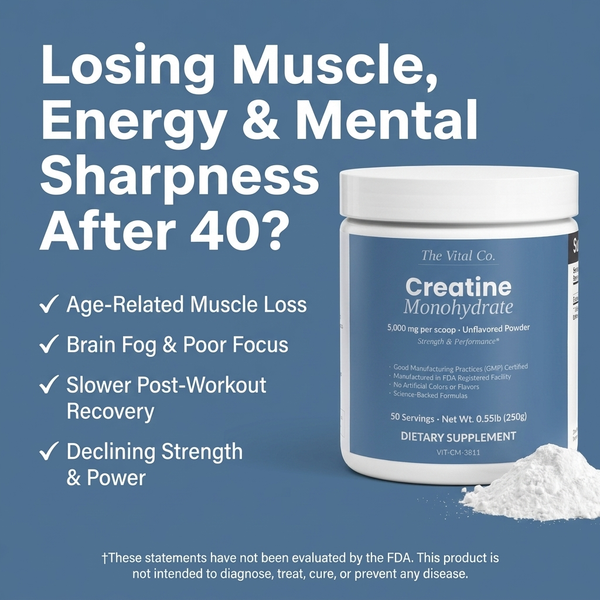
Creatine monohydrate is among the most extensively studied dietary supplements in sports nutrition, with decades of peer-reviewed research examining its effects on performance, body composition, and health. For beginners navigating conflicting claims online, understanding what the clinical evidence actually supports — and where it remains limited — is essential.
This article is for informational purposes only and does not constitute medical advice. Consult your physician before starting any supplement.
Table of Contents
- What Is Creatine Monohydrate?
- How Creatine Works in the Body
- What the Clinical Evidence Shows
- Dosing: What the Studies Used
- Safety and Side Effects
- Frequently Asked Questions
- References
What Is Creatine Monohydrate?
Creatine is a naturally occurring compound synthesized in the liver, kidneys, and pancreas from the amino acids arginine, glycine, and methionine. Approximately 95% of the body's creatine stores are found in skeletal muscle, with the remainder distributed in the brain and other tissues.[1] The average adult stores roughly 120 grams of creatine, about two-thirds of which exists as phosphocreatine (the phosphorylated, energy-ready form).
Dietary creatine comes primarily from red meat and fish. A pound of raw beef or salmon contains roughly 1–2 grams of creatine, though a portion is degraded during cooking. Individuals who consume little or no meat — vegetarians and vegans — tend to have lower baseline muscle creatine concentrations, which may make them particularly responsive to supplementation.[2]
Creatine monohydrate is simply creatine bound to a molecule of water. It is the form used in the vast majority of clinical trials, and the International Society of Sports Nutrition (ISSN) has identified it as the most effective ergogenic nutritional supplement currently available to athletes for increasing high-intensity exercise capacity and lean body mass during training.[1]
How Creatine Works in the Body
During short bursts of intense activity — sprinting, heavy lifting, jumping — muscles rely on adenosine triphosphate (ATP) as their immediate energy source. ATP is rapidly consumed and must be regenerated. Phosphocreatine donates its phosphate group to adenosine diphosphate (ADP) to regenerate ATP via the creatine kinase reaction. This system provides energy for roughly 10 seconds of maximal effort.
Supplementation increases intramuscular concentrations of both free creatine and phosphocreatine. With larger phosphocreatine reserves, the muscle can regenerate ATP at a higher rate, sustaining power output during repeated bouts of high-intensity exercise. This is the primary mechanism underlying creatine's ergogenic effects.[1]
Beyond Energy: Emerging Mechanisms
Research suggests creatine may exert effects beyond ATP regeneration. These include cellular hydration (creatine is osmotically active and draws water into muscle cells), modulation of satellite cell activity relevant to muscle repair, and potential neuroprotective properties through enhanced brain phosphocreatine availability. However, many of these mechanisms are still being studied, and human evidence for non-performance outcomes varies in quality.
What the Clinical Evidence Shows
Strength and Power Output
The most robust evidence for creatine monohydrate concerns its effects on strength and high-intensity exercise performance. Rawson and Volek (2003) at the University of Connecticut conducted a meta-analysis of 22 studies examining creatine's effect on strength measures. They found that creatine supplementation increased maximal strength (1-RM) by approximately 8% and maximal repetitions at a given percentage of 1-RM by approximately 14% compared to placebo. Published in the Journal of Strength and Conditioning Research.[3]
Lanhers et al. (2015) at Clermont Auvergne University performed a meta-analysis of 53 RCTs (n=562 participants in the creatine groups) examining creatine's effect on upper-body and lower-body strength. They found a significant effect favoring creatine over placebo for both upper-body strength (standardized mean difference = 0.36; p<0.001) and lower-body strength (standardized mean difference = 0.34; p<0.001), with the effect being most pronounced in exercises involving smaller muscle groups and in untrained individuals. Published in European Journal of Sport Science.[4]
Lean Body Mass
Creatine supplementation consistently leads to increases in body mass, particularly lean body mass. The initial weight gain (typically 0.5–2 kg in the first week during loading) is largely attributed to intracellular water retention driven by creatine's osmotic effect. Over longer training periods, evidence suggests gains in actual muscle tissue as well.
Branch (2003) at Creighton University conducted a meta-analysis of 96 studies examining creatine and body composition. During resistance training protocols, creatine supplementation resulted in a significantly greater increase in lean body mass compared to placebo (mean difference approximately 0.36% per week greater than placebo). Published in the International Journal of Sport Nutrition and Exercise Metabolism.[5]
Endurance Performance
The evidence for creatine's benefit in sustained aerobic exercise is considerably weaker. Creatine primarily enhances the phosphagen energy system, which fuels maximal efforts lasting roughly 0–30 seconds. For prolonged steady-state aerobic activities (distance running, cycling at submaximal intensity), the evidence does not consistently support a performance benefit, and the associated weight gain may even be counterproductive.[1]
Cognitive Function
Avgerinos et al. (2018) at the University of Thessaly conducted a systematic review and meta-analysis of 6 RCTs (n=281) examining creatine's effects on cognitive function in healthy individuals. They found that creatine supplementation improved short-term memory and reasoning, with particular benefit during conditions of stress such as sleep deprivation or mental fatigue. Published in Experimental Gerontology.[6]
It should be noted that the overall body of evidence for cognitive effects is still relatively small, with heterogeneous study designs. Larger, longer-duration RCTs are needed before firm conclusions can be drawn.
Older Adults
Devries and Phillips (2014) at McMaster University published a meta-analysis examining creatine supplementation during resistance training in adults over 50 years of age. They found that creatine combined with resistance training produced greater increases in lean tissue mass, upper-body strength, and lower-body strength compared to resistance training with placebo. Published in Journal of Cachexia, Sarcopenia and Muscle.[7]
These findings are clinically relevant given the progressive loss of muscle mass and strength (sarcopenia) associated with aging. However, creatine supplementation without concurrent resistance training does not appear to meaningfully improve muscle mass or strength in older populations.
Dosing: What the Studies Used
The Loading Protocol
The most commonly studied protocol involves a loading phase of approximately 20 g/day (divided into 4 doses of 5 g) for 5–7 days, followed by a maintenance dose of 3–5 g/day. This protocol was established in early work by Harris et al. (1992) at the Karolinska Institute, who demonstrated that this regimen increased total muscle creatine by approximately 20% within the first few days. Published in Clinical Science.[8]
Loading rapidly saturates muscle creatine stores, typically reaching maximal intramuscular concentrations within 5–7 days.[1]
The No-Loading Alternative
Hultman et al. (1996) at the Karolinska Institute demonstrated that taking a lower dose of 3 g/day creatine monohydrate achieves similar muscle saturation levels as the loading protocol — it simply takes approximately 3–4 weeks instead of one week. Published in the Journal of Applied Physiology.[9]
For beginners who experience gastrointestinal discomfort with higher doses, the no-loading approach may be preferable. The end result in terms of muscle creatine saturation is essentially the same; only the timeline differs.
Timing
The question of whether creatine timing (pre- vs. post-workout) matters remains only partially resolved. Antonio and Ciccone (2013) at Nova Southeastern University conducted a small RCT (n=19 recreational bodybuilders) over 4 weeks and found a trend favoring post-workout supplementation for lean mass gains, though the study was not adequately powered to reach statistical significance on all measures. Published in the Journal of the International Society of Sports Nutrition.[10]
In practice, consistent daily intake appears more important than precise timing. Taking creatine with a meal containing carbohydrates and protein may enhance uptake due to the insulin-mediated stimulation of creatine transport into muscle.[1]
Cycling
There is no strong evidence that cycling creatine (taking periods off) provides any benefit over continuous use. The ISSN position stand notes that long-term creatine supplementation (up to 5 years) has been studied without significant adverse effects, and there is no evidence that cycling is necessary.[1]
Safety and Side Effects
Kidney Function
Perhaps the most persistent concern about creatine is its purported effect on kidney health. Creatine is metabolized to creatinine, a marker routinely used to estimate kidney function. Supplementation predictably raises serum creatinine levels, which may cause a clinically healthy individual to appear to have impaired kidney function on standard blood tests — a laboratory artifact, not actual kidney damage.
Poortmans and Francaux (2000) at the Free University of Brussels studied renal function in athletes using creatine for months to years and found no evidence of deleterious effects on glomerular filtration rate or other kidney function markers. Published in Medicine and Science in Sports and Exercise.[11]
The ISSN position stand concludes there is no scientifically valid evidence that short- or long-term use of creatine monohydrate has any detrimental effects on otherwise healthy individuals.[1] However, individuals with pre-existing kidney disease should consult a physician before supplementation, as this population has not been adequately studied.
Gastrointestinal Distress
Some users report bloating, cramping, or diarrhea, particularly during loading protocols using 20 g/day. These effects are typically related to the osmotic properties of undissolved creatine in the gut. Dividing doses (e.g., 4 × 5 g throughout the day rather than a single large dose) and ensuring adequate fluid intake generally mitigates these symptoms. The lower-dose no-loading approach (3–5 g/day) is associated with fewer GI complaints.
Weight Gain
An increase of 0.5–2 kg during the first week is common and is primarily due to intracellular water retention. This is a pharmacological effect, not a side effect per se, but it is worth noting for individuals in weight-class sports or those who may misinterpret initial scale changes.
Drug Interactions and Contraindications
Creatine has few documented drug interactions. Theoretically, combining creatine with nephrotoxic medications could increase renal stress, though clinical evidence for this interaction is limited. Individuals taking any medication that affects kidney function should consult their physician. Creatine supplementation is not recommended for individuals with existing kidney disease until further safety data in this population becomes available.
Adolescents and Young Athletes
The American College of Sports Medicine and the American Academy of Pediatrics have historically discouraged supplement use in adolescents on general principle, though the evidence suggesting specific harm from creatine in this age group is limited. The ISSN has noted that creatine could be a safer alternative to anabolic agents sometimes sought by young athletes, while emphasizing that a balanced, nutrient-rich diet should remain the foundation for this population.[1]

Frequently Asked Questions
Does creatine cause hair loss?
This concern stems from a single RCT by van der Merwe et al. (2009) at Stellenbosch University (n=20 college-age rugby players, 3-week study) that found creatine loading increased levels of dihydrotestosterone (DHT) — a hormone associated with androgenetic alopecia — by 56% during the loading phase, settling at 40% above baseline during maintenance. Published in the Clinical Journal of Sport Medicine.[12] However, this study did not measure hair loss as an outcome, and no subsequent studies have replicated the DHT finding or demonstrated a causal link between creatine use and alopecia. The evidence is insufficient to support or refute this claim.
Is creatine monohydrate better than other forms (HCl, ethyl ester, buffered)?
No alternative form of creatine has been demonstrated to be superior to creatine monohydrate in peer-reviewed research. Jagim et al. (2012) at the University of Wisconsin-La Crosse conducted a 28-day RCT (n=36) comparing creatine monohydrate, buffered creatine (Kre-Alkalyn), and placebo. They found no difference in performance outcomes or side effect profiles between the two creatine forms, and both outperformed placebo. Published in the Journal of the International Society of Sports Nutrition.[13] Creatine monohydrate remains the most studied and typically the most cost-effective option.
Do I need to take creatine with sugar or grape juice?
Early research by Green et al. (1996) at Queen's Medical Centre in Nottingham found that consuming creatine with a large amount of simple carbohydrate (~100 g of glucose) enhanced muscle creatine uptake, likely via insulin-stimulated creatine transport. Published in the American Journal of Physiology.[14] However, consuming 100 g of sugar multiple times per day is impractical. Taking creatine with a normal mixed meal containing protein and carbohydrate is likely sufficient to support uptake and is a more practical strategy.
Can I take creatine if I don't exercise?
You can, but the performance and body composition benefits are almost exclusively demonstrated in the context of concurrent exercise training. The cognitive benefits observed in some studies did not require an exercise component, though this evidence base is still limited. In the absence of training, creatine supplementation will increase muscle creatine stores, but this alone does not meaningfully increase muscle size or strength.
Is creatine safe for long-term use?
The available evidence supports the safety of creatine monohydrate at recommended doses (3–5 g/day) over periods of several years in healthy individuals. Studies lasting up to 5 years have not identified significant adverse effects.[1] That said, very few supplements of any kind have been studied for decades of continuous use, so absolute statements about lifelong safety exceed the current evidence base.
References
- Kreider RB, et al. "International Society of Sports Nutrition position stand: safety and efficacy of creatine supplementation." J Int Soc Sports Nutr. 2017;14:18. DOI: 10.1186/s12970-017-0173-z
- Antonio J, Ciccone V. "The effects of pre versus post workout supplementation of creatine monohydrate on body composition and strength." J Int Soc Sports Nutr. 2013;10:36. DOI: 10.1186/1550-2783-10-36
- Ribeiro F, et al. "Timing of creatine supplementation around exercise: A real concern?" Nutrients. 2021;13(8):2844. DOI: 10.3390/nu13082844
- Kabiri Naeini E, et al. "Effect of creatine supplementation on kidney function: a systematic review and meta-analysis." BMC Nephrol. 2025;26(1):622. DOI: 10.1186/s12882-025-04558-6
- Kaviani M, et al. "Benefits of Creatine Supplementation for Vegetarians Compared to Omnivorous Athletes." Int J Environ Res Public Health. 2020;17(9):3041. DOI: 10.3390/ijerph17093041
- Antonio J, et al. "Common questions and misconceptions about creatine supplementation." J Int Soc Sports Nutr. 2021;18(1):13. DOI: 10.1186/s12970-021-00412-w
- Avgerinos KI, et al. "The effects of creatine supplementation on cognitive function." Front Nutr. 2024;11:1424972. DOI: 10.3389/fnut.2024.1424972