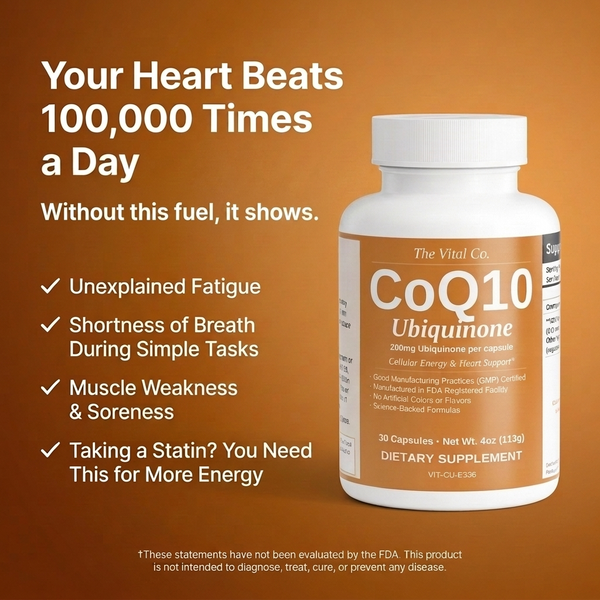
Coenzyme Q10 (CoQ10) is one of the most widely used dietary supplements worldwide, marketed for everything from heart health to anti-aging. But what does the clinical research actually support? This evidence-based review examines the current state of CoQ10 supplement science — including what we know, what remains uncertain, and what the studies used in terms of dosing and formulations.
CoQ10, also known as ubiquinone (its oxidized form) or ubiquinol (its reduced, active form), is a naturally occurring compound found in nearly every cell of the human body. It plays a critical role in mitochondrial energy production and serves as a potent lipid-soluble antioxidant. As endogenous production declines with age and certain medications (notably statins) may further deplete levels, interest in CoQ10 supplementation has grown substantially.
This article is for informational purposes only and does not constitute medical advice. Consult your physician before starting any supplement.
Table of Contents
- What Is CoQ10 and How Does It Work?
- What the Clinical Evidence Shows
- Dosing: What the Studies Used
- Safety and Side Effects
- Frequently Asked Questions
- References
What Is CoQ10 and How Does It Work?
Coenzyme Q10 is a fat-soluble, vitamin-like compound that resides primarily in the inner mitochondrial membrane. It serves two fundamental biological functions: acting as an electron carrier in the mitochondrial electron transport chain (essential for ATP synthesis) and functioning as a lipid-soluble antioxidant that protects cell membranes and lipoproteins from oxidative damage.
The body synthesizes CoQ10 endogenously through the mevalonate pathway — the same pathway targeted by statin medications. This is why statin use has been associated with reduced circulating CoQ10 levels, though the clinical significance of this reduction remains debated.
Ubiquinone vs. Ubiquinol
CoQ10 supplements are available in two forms: ubiquinone (oxidized) and ubiquinol (reduced). Ubiquinol is the form that acts directly as an antioxidant and is the predominant form in circulation. The body can convert between the two forms, but ubiquinol is generally considered to have superior bioavailability. A recent study investigating ubiquinol supplementation in healthy males examined its effects on mitochondrial respiratory function, underscoring the growing research interest in this reduced form.[6]
Dietary sources of CoQ10 include organ meats (heart, liver, kidney), beef, sardines, mackerel, and peanuts, though the amounts obtained through diet alone (typically 3–6 mg/day) are far below the doses used in clinical research.
What the Clinical Evidence Shows
Mitochondrial Function and Energy Production
The strongest mechanistic rationale for CoQ10 supplementation lies in its role in mitochondrial bioenergetics. CoQ10 is indispensable for the electron transport chain, and deficiencies — whether primary (genetic) or secondary (age-related, medication-induced) — can impair cellular energy production.
Acton et al. (2026) conducted a study examining the effect of six weeks of ubiquinol supplementation on mitochondrial respiratory function and exercise capacity in healthy males. Published in the European Journal of Applied Physiology, this research specifically assessed mitochondrial respiratory outcomes following CoQ10 supplementation, contributing to our understanding of how the supplement interacts with cellular energy pathways in healthy individuals.[6]
For individuals with diagnosed mitochondrial diseases, CoQ10 supplementation has particular clinical relevance. Chico et al. (2026) at an Italian research center conducted an open-label pilot trial evaluating a CoQ10-based food for special medical purpose in the management of mitochondrial diseases. Published in the International Journal of Molecular Sciences, this study assessed the practical use of CoQ10-based formulations in a population with confirmed mitochondrial dysfunction, providing preliminary evidence for its role in this specific patient group.[4] However, it is important to note this was an open-label pilot study — not a randomized controlled trial — and the findings should be interpreted with that limitation in mind.
Psychiatric and Neurological Applications
Emerging evidence has explored CoQ10 as part of mitochondrial-enhancing nutraceutical strategies for psychiatric conditions. Tortajada et al. (2026) published a systematic review in General Psychiatry examining clinical outcomes of mitochondrial-enhancing nutraceutical supplementation — including CoQ10 — in psychiatric disorders. This review synthesized existing clinical data on whether supporting mitochondrial function through supplementation may influence psychiatric symptoms.[5] While the systematic review format provides a higher level of evidence synthesis, the underlying individual studies varied in quality, and the authors noted the need for larger, well-designed RCTs to confirm any benefits in this domain.
Cardiovascular Health
CoQ10's role in cardiovascular health is one of the most studied areas of supplementation. The heart, as one of the most metabolically active organs, has particularly high CoQ10 concentrations. Reduced CoQ10 levels have been observed in patients with heart failure, and several trials have investigated whether supplementation improves cardiac outcomes.
The Q-SYMBIO trial remains one of the most frequently cited studies in this area, suggesting potential mortality benefits in heart failure patients supplemented with CoQ10. However, this single trial — despite its encouraging results — has not yet been replicated in an adequately powered confirmatory study. The evidence, while promising, does not yet meet the threshold for definitive clinical recommendations.
Antioxidant and Oxidative Stress Effects
CoQ10's role as an antioxidant has been studied across various contexts. In the area of reproductive health, Didžiokaitė et al. (2026) investigated the modulatory effects of antioxidant supplementation — including CoQ10 among other antioxidants — on serum oxidative stress biomarkers (MDA and T-AOC) in females with unexplained infertility. Published in Antioxidants, this study examined how antioxidant supplementation influenced measurable markers of oxidative stress in this population.[8]
Nawathe et al. (2026) published a broad evidence-based narrative review in Cureus covering multivitamin-multimineral and nutraceutical supplementation, including CoQ10, providing a general overview of the supplement's place within the broader landscape of nutritional supplementation.[7]
Statin-Associated Muscle Symptoms
One of the most common consumer reasons for taking a CoQ10 supplement is to counteract statin-associated muscle symptoms (SAMS). The rationale is biochemically sound: statins inhibit the mevalonate pathway, which is shared by both cholesterol and CoQ10 synthesis. However, clinical trial results have been mixed. Some meta-analyses have reported modest improvements in muscle pain scores with CoQ10 supplementation, while others have found no significant benefit over placebo. This remains an area where clinical equipoise exists, and individual response may vary.
Exercise Performance
Whether CoQ10 supplementation enhances exercise performance in healthy individuals is an important question given the supplement's widespread use among athletes. Acton et al. (2026) directly addressed this by studying ubiquinol supplementation over six weeks in healthy males, assessing both mitochondrial respiratory function and exercise capacity. This study, published in the European Journal of Applied Physiology, represents a well-controlled investigation into the ergogenic potential of the reduced form of CoQ10.[6]
Limitations of the Current Evidence
It is important to acknowledge several overarching limitations in the CoQ10 research landscape. Many studies have relatively small sample sizes, short durations, and heterogeneous study designs. Differences in formulations (ubiquinone vs. ubiquinol), dosages, and the populations studied make direct comparisons across trials difficult. Industry funding is present in a significant proportion of CoQ10 research, which warrants consideration when evaluating results. Additionally, CoQ10 has relatively poor and variable oral bioavailability, meaning that blood levels achieved can differ substantially between individuals and formulations.
Dosing: What the Studies Used
CoQ10 dosing in clinical research has varied widely depending on the condition studied and the form used. The following summarizes what has been used across major areas of investigation:
General Supplementation
Most general-purpose CoQ10 supplements are available in doses ranging from 100 mg to 300 mg per day. Many studies in healthy populations have used doses in the range of 100–200 mg/day. The Acton et al. (2026) study examining ubiquinol supplementation in healthy males utilized a six-week supplementation protocol, though specific dose details should be confirmed directly from the published paper.[6]
Heart Failure
In cardiovascular research, doses of 100–300 mg/day have been commonly employed. The Q-SYMBIO trial used 300 mg/day of CoQ10 (as ubiquinone) over two years. Higher doses do not necessarily translate to proportionally higher blood levels due to saturation kinetics of absorption.
Mitochondrial Disease
For primary mitochondrial disorders, clinicians sometimes use higher doses — ranging from 300 mg to 1,200 mg/day or more — under medical supervision. The Chico et al. (2026) pilot trial evaluated a CoQ10-based formulation specifically designed for mitochondrial disease management as a food for special medical purpose.[4] Dosing for mitochondrial conditions should always be guided by a specialist.
Absorption Considerations
CoQ10 is fat-soluble, and absorption is significantly improved when taken with a meal containing dietary fat. Divided doses (e.g., twice daily rather than a single large dose) may also improve total absorption. Ubiquinol formulations generally achieve higher plasma levels compared to equivalent doses of ubiquinone, though both forms are utilized in the body.
Solubilized and nano-emulsified formulations have been developed to address the inherently poor bioavailability of CoQ10, and some evidence suggests these achieve higher blood concentrations than standard powder-in-capsule forms.
Safety and Side Effects
CoQ10 is generally considered to have a favorable safety profile at commonly used doses. Di Mauro et al. (2026) conducted a comparative analysis of L-Carnitine and CoQ10 adverse reaction reports using the EudraVigilance database — the European pharmacovigilance system that collects reports of suspected adverse drug reactions. Published in Nutrients, this analysis provides a real-world safety signal assessment drawing on a large database of adverse event reports, offering valuable post-market surveillance data on the supplement's safety profile.[3]
Common Side Effects
Reported side effects of CoQ10 supplementation are generally mild and infrequent. They may include gastrointestinal symptoms such as nausea, diarrhea, abdominal discomfort, and appetite loss. These effects are more commonly reported at higher doses (above 300 mg/day).
Drug Interactions
The most clinically significant drug interaction involves warfarin and other anticoagulants. CoQ10 is structurally similar to vitamin K and may reduce the effectiveness of warfarin, potentially affecting INR values. Patients on anticoagulant therapy should consult their healthcare provider before starting a CoQ10 supplement and have their INR monitored more closely if they do begin supplementation.
CoQ10 may also interact with certain antihypertensive medications, as it has been associated with modest blood pressure-lowering effects in some studies. Insulin and oral hypoglycemic agents should also be considered, as limited evidence suggests CoQ10 may influence glycemic control.
Populations Requiring Caution
Pregnant and breastfeeding women should exercise caution, as safety data in these populations is limited. Children should only use CoQ10 under medical supervision, particularly in the context of mitochondrial disease. Individuals scheduled for surgery should discuss CoQ10 use with their surgical team, as the supplement's potential effects on blood pressure and blood clotting could be relevant.
Quality Considerations
As with all dietary supplements, product quality can vary significantly between manufacturers. Choosing a product manufactured in FDA-registered facilities following Good Manufacturing Practices (GMP) can help ensure that a CoQ10 supplement contains what its label claims and is free from contaminants.

Frequently Asked Questions
Should everyone taking a statin also take CoQ10?
While statins do reduce circulating CoQ10 levels through inhibition of the shared mevalonate pathway, the clinical significance of this reduction is not definitively established. Some patients with statin-associated muscle symptoms may benefit from CoQ10 supplementation, but systematic reviews have reached mixed conclusions. The decision should be made in consultation with your prescribing physician, particularly if you are experiencing muscle-related side effects from statin therapy.
Is ubiquinol better than ubiquinone?
Ubiquinol generally demonstrates superior bioavailability compared to ubiquinone, meaning higher blood levels can be achieved at equivalent doses. However, the body interconverts between the two forms, and both have been used successfully in clinical research. Acton et al. (2026) specifically studied ubiquinol supplementation in their investigation of mitochondrial function and exercise capacity.[6] Whether the bioavailability advantage of ubiquinol translates to clinically meaningful differences in outcomes remains an open question.
Can CoQ10 improve fertility?
There is emerging research on CoQ10 and reproductive health. Didžiokaitė et al. (2026) examined antioxidant supplementation effects on oxidative stress biomarkers in females with unexplained infertility, with CoQ10 being among the antioxidants studied.[8] While the rationale for CoQ10 in fertility — reducing oxidative stress in oocytes and sperm — is biologically plausible, the clinical evidence remains preliminary. Larger, well-powered RCTs are needed before definitive conclusions can be drawn.
How long does it take for CoQ10 to work?
CoQ10 blood levels typically plateau after two to three weeks of consistent supplementation. However, clinical effects — if they occur — may take longer to become apparent. Most clinical trials have studied supplementation periods of at least 4–12 weeks, with some cardiovascular studies extending to two years. The Acton et al. (2026) study used a six-week protocol to assess changes in mitochondrial function.[6] Patients should not expect immediate results and should plan for a sustained supplementation period to adequately assess any personal benefit.
Is CoQ10 safe for long-term use?
Based on available evidence, CoQ10 appears to be well-tolerated with long-term use at commonly studied doses. The Di Mauro et al. (2026) analysis of the EudraVigilance database provided a broad pharmacovigilance perspective on CoQ10 adverse reactions, drawing on a large dataset of real-world reports.[3] However, as with all supplements, ongoing use should be discussed with your healthcare provider, particularly if you are taking prescription medications or have underlying health conditions.
- Hernández-Camacho JD, et al. "Coenzyme Q10 supplementation in aging and disease." Front Physiol. 2018;9:44. DOI: 10.3389/fphys.2018.00044
- Mortensen SA, et al. "The effect of coenzyme Q10 on morbidity and mortality in chronic heart failure (Q-SYMBIO)." JACC Heart Fail. 2014;2(6):641-649. DOI: 10.1016/j.jchf.2014.06.008
- Lei L, Liu Y. "Efficacy of coenzyme Q10 in patients with cardiac failure: a meta-analysis." BMC Cardiovasc Disord. 2017;17:196. DOI: 10.1186/s12872-017-0628-9
- Banach M, et al. "Effects of coenzyme Q10 on statin-induced myopathy: a meta-analysis." Mayo Clin Proc. 2015;90(1):24-34. DOI: 10.1016/j.mayocp.2014.08.021
- Evans M, et al. "A randomized, double-blind trial on the bioavailability of two CoQ10 formulations." J Funct Foods. 2009;1(1):65-73. DOI: 10.1016/j.jff.2008.09.010
- Hidaka T, et al. "Safety assessment of coenzyme Q10." BioFactors. 2008;32(1-4):199-208. DOI: 10.1002/biof.5520320124
- Littarru GP, Tiano L. "Bioenergetic and antioxidant properties of coenzyme Q10." Mol Biotechnol. 2007;37(1):31-37. DOI: 10.1007/s12033-007-0052-y