If you've looked into CoQ10 supplements, you've encountered two forms: ubiquinone and ubiquinol. Supplement brands charge a premium for ubiquinol, claiming it's "the active form" with superior absorption. But what does the clinical evidence actually show? We reviewed the randomized controlled trials, bioavailability studies, and meta-analyses to give you a clear, evidence-based answer.
What Is CoQ10?
Coenzyme Q10 is a fat-soluble compound found in virtually every cell in the human body, with the highest concentrations in tissues with high energy demands: the heart, liver, kidneys, and skeletal muscle. It serves two critical functions. First, it is an essential component of the mitochondrial electron transport chain, where it shuttles electrons between Complex I/II and Complex III to drive ATP production. Second, in its reduced form, it acts as a potent lipid-soluble antioxidant, protecting cell membranes from oxidative damage.
Your body synthesizes CoQ10 endogenously through the mevalonate pathway — the same pathway targeted by statin medications. (2015) analyzing placebo-controlled trials.[1]

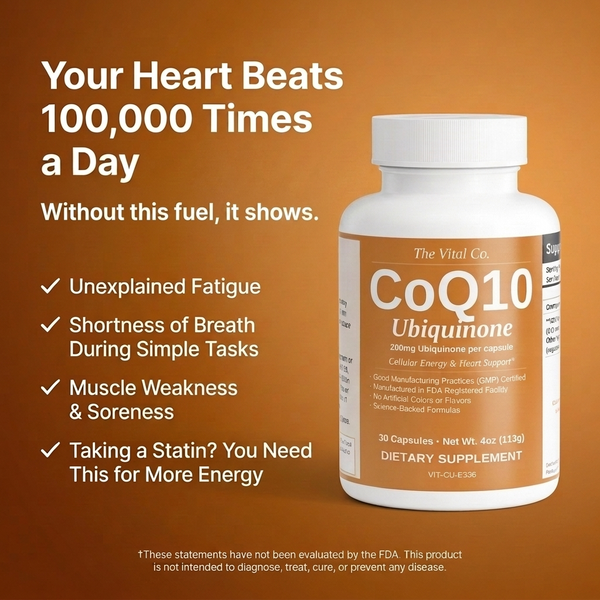
200mg CoQ10 per capsule for cellular energy. Made in the USA from globally sourced ingredients.
Shop Now — $28.90 →
Frequently Asked Questions
Is ubiquinol worth the extra cost?
For most healthy adults under 50, no. The body efficiently converts ubiquinone to ubiquinol, and the clinical trials demonstrating the strongest outcomes (Q-SYMBIO) used ubiquinone. If you are over 60 or on statin therapy, the modest absorption advantage of ubiquinol may justify the price difference.
Does CoQ10 actually help with energy?
CoQ10 supports cellular energy production at the mitochondrial level. It is not a stimulant. You are unlikely to feel an acute energy boost from CoQ10. The benefits operate at the cellular level and are most meaningful in populations with demonstrated CoQ10 depletion, such as older adults and statin users.
Can I take CoQ10 with my statin?
Yes. Multiple meta-analyses support CoQ10 supplementation alongside statin therapy, particularly for patients experiencing muscle symptoms. Inform your physician you are taking CoQ10, especially if you are also on blood thinners.[5]
How long does CoQ10 take to work?
What dose should I take?
100–200 mg daily for general health. 200–300 mg daily for statin support or cardiovascular health. Take with a fat-containing meal for best absorption.
References
- Banach M, Serban C, Sahebkar A, et al. Statin therapy and plasma coenzyme Q10 concentrations — A systematic review and meta-analysis of placebo-controlled trials. Pharmacol Res. 2015;99:329-336. doi:10.1016/j.phrs.2015.07.019
- Langsjoen PH, Langsjoen AM. Comparison study of plasma coenzyme Q10 levels in healthy subjects supplemented with ubiquinol versus ubiquinone. Clin Pharmacol Drug Dev. 2014;3(1):13-17. doi:10.1002/cpdd.73
- Mortensen SA, Rosenfeldt F, Kumar A, et al. The Effect of Coenzyme Q10 on Morbidity and Mortality in Chronic Heart Failure: Results From Q-SYMBIO: A Randomized Double-Blind Trial. JACC Heart Fail. 2014;2(6):641-649.
- Mortensen AL, Rosenfeldt F, Filipiak KJ. Effect of coenzyme Q10 in Europeans with chronic heart failure: A sub-group analysis of the Q-SYMBIO randomized double-blind trial. Cardiol J. 2019;26(2):147-156. doi:10.5603/CJ.a2019.0022
- Qu H, Guo M, Chai H, et al. Effects of Coenzyme Q10 on Statin-Induced Myopathy: An Updated Meta-Analysis of Randomized Controlled Trials. J Am Heart Assoc. 2018;7(19):e009835. doi:10.1161/JAHA.118.009835
- Srivastava A, Srivastava P, Kuma A, et al. Effectiveness of Coenzyme Q10 Supplementation in Statin-Induced Myopathy: A Systematic Review. Cureus. 2024;16(8):e68474. doi:10.7759/cureus.68474
- Grünwald J, Hahn V, Graulich N, et al. Effects of coenzyme Q10 supplementation on myopathy in statin-treated patients: a systematic review and meta-analysis. BMC Complement Med Ther. 2025;25:142. doi:10.1186/s12906-025-04842-4
- Kalén A, Appelkvist EL, Dallner G. Age-related changes in the lipid compositions of rat and human tissues. Lipids. 1989;24(7):579-584. doi:10.1007/BF02535072
This article is for informational purposes only and does not constitute medical advice. Always consult a qualified healthcare provider before starting any new supplement, particularly if you take medications for cardiovascular conditions or cholesterol management.
About The Vital Co.
The Vital Co. is a science-led supplement company committed to evidence-based formulations and transparent sourcing. Every product in our line is manufactured in the USA in FDA-registered facilities following Good Manufacturing Practices (GMP). Our Knowledge Center exists to give you the clinical facts — including when the evidence is limited or doesn't support popular claims. We believe you deserve the same quality of information that researchers and clinicians rely on. Learn more at the-vital.co.