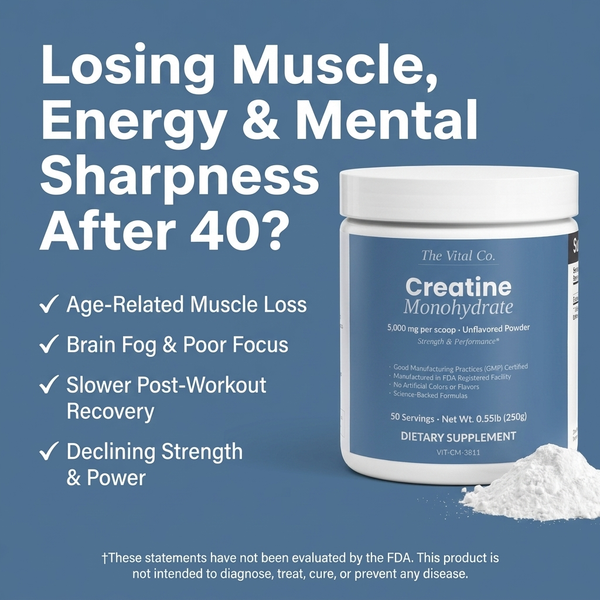
Creatine monohydrate is one of the most extensively studied ergogenic supplements in sports nutrition history, with hundreds of peer-reviewed studies spanning more than three decades. Yet despite this deep evidence base, misconceptions persist about what creatine does, who it helps, and whether it is safe. This article examines the clinical evidence for creatine benefits across performance, body composition, cognitive function, and emerging therapeutic applications.
This article is for informational purposes only and does not constitute medical advice. Consult your physician before starting any supplement.
Table of Contents
- What Is Creatine and How Does It Work?
- What the Clinical Evidence Shows
- Dosing: What the Studies Used
- Safety and Side Effects
- Frequently Asked Questions
- References
What Is Creatine and How Does It Work?
Creatine is a naturally occurring compound synthesized in the liver, kidneys, and pancreas from three amino acids: arginine, glycine, and methionine. The body produces approximately 1–2 grams of creatine per day endogenously, and additional creatine is obtained from dietary sources — primarily red meat and fish — at roughly 1–2 grams per day in a typical omnivorous diet.
Approximately 95% of the body's creatine stores reside in skeletal muscle, with the remaining 5% distributed among the brain, kidneys, and liver. Within muscle cells, creatine exists in two forms: free creatine and phosphocreatine (PCr). Phosphocreatine serves as a rapid energy reservoir, donating its phosphate group to adenosine diphosphate (ADP) to regenerate adenosine triphosphate (ATP) during high-intensity, short-duration activities. This reaction is catalyzed by the enzyme creatine kinase.
The Bioenergetic Rationale for Supplementation
At rest, skeletal muscle creatine stores are typically saturated to about 60–80% of their capacity. Creatine supplementation aims to elevate intramuscular creatine and phosphocreatine concentrations closer to full saturation — an increase of roughly 20–40%. By expanding the phosphocreatine pool, the ATP-PCr energy system can sustain high-intensity muscular effort for slightly longer periods before fatigue onset. This is the primary mechanism underlying most of creatine's well-documented performance benefits.
It is important to note that not all individuals respond equally to creatine supplementation. Research suggests that individuals with lower baseline intramuscular creatine levels — including vegetarians and vegans — tend to experience greater increases in muscle creatine content and, consequently, more pronounced performance benefits. Conversely, individuals with already near-saturated muscle creatine stores may experience minimal benefit.
What the Clinical Evidence Shows
Strength and Power Output
The evidence for creatine's effects on strength and power output is among the most robust in sports nutrition. Multiple meta-analyses have reported that creatine supplementation, combined with resistance training, increases maximal strength (1-repetition maximum) by approximately 5–10% more than resistance training with placebo. These improvements are most consistently observed in compound movements such as the bench press and squat.
The mechanism here is straightforward: by increasing phosphocreatine availability, creatine allows athletes to perform more total work per training session — additional repetitions, additional sets, or slightly higher loads. Over weeks and months, this incremental increase in training volume compounds into greater strength adaptations.
Anaerobic and Aerobic Performance
A 2026 systematic review and network meta-analysis by Bai and Xu, published in the Journal of the International Society of Sports Nutrition, examined the effects of combined versus single supplementation of creatine and beta-alanine on aerobic and anaerobic performance. This meta-analysis found that creatine supplementation — both alone and in combination with beta-alanine — influenced measures of aerobic and anaerobic capacity, with the network meta-analysis framework allowing for indirect comparisons across supplement protocols.
It is worth noting that creatine's performance effects are most pronounced in short-duration, high-intensity activities lasting up to approximately 30 seconds. For sustained aerobic exercise, the evidence for direct performance enhancement is less consistent, though indirect benefits — such as enhanced recovery between high-intensity interval training bouts — have been documented.
Lean Body Mass and Body Composition
Creatine supplementation is consistently associated with increases in lean body mass. However, interpreting these findings requires nuance. In the initial days of supplementation, weight gain of 1–2 kg is typical and is largely attributable to increased intracellular water retention driven by creatine's osmotic properties. Over longer periods of supplementation combined with resistance training, genuine increases in muscle protein accretion appear to contribute to additional lean mass gains beyond water retention alone.
The proposed mechanism for creatine's effects on muscle hypertrophy involves multiple pathways: increased training volume capacity (as noted above), enhanced satellite cell activity, elevated expression of myogenic regulatory factors, and possible upregulation of insulin-like growth factor-1 (IGF-1) signaling within muscle tissue. However, the relative contribution of each pathway remains an active area of investigation.
Musculoskeletal Health and Inflammatory Conditions
An emerging area of creatine research involves its potential role in chronic musculoskeletal pain and rheumatological conditions. Salazar-Méndez, Núñez-Cortés, Salazar-Orellana, and colleagues (2026) conducted a systematic review published in Nutrition examining the impact of creatine supplementation — alone or combined with exercise — on inflammatory and clinical outcomes in chronic musculoskeletal pain treated in the rheumatological field. This review synthesized the available evidence on creatine's potential anti-inflammatory properties and its effects on clinical outcomes in these patient populations.[2]
The biological plausibility for creatine's effects in inflammatory conditions centers on its role in cellular energy metabolism. Chronic inflammatory states are associated with increased metabolic demand on affected tissues. By supporting cellular energy availability through phosphocreatine buffering, creatine may help maintain tissue function under inflammatory stress. However, this area of research is still developing, and the strength of the current evidence base does not yet support definitive therapeutic claims.
Cognitive Function and Neuroprotection
The brain, despite representing only about 2% of body mass, accounts for approximately 20% of the body's resting energy expenditure. Brain tissue expresses creatine kinase and maintains its own phosphocreatine pool, which supports rapid ATP regeneration during periods of high cognitive demand. This bioenergetic framework provides the rationale for investigating creatine's cognitive effects.
Preliminary studies suggest creatine supplementation may improve short-term memory and reasoning under conditions of cognitive stress, such as sleep deprivation or demanding mental tasks. The evidence is particularly suggestive in vegetarians and vegans, who tend to have lower baseline brain creatine levels. However, the cognitive evidence base is considerably smaller and less mature than the exercise performance literature, and many studies have been small in scale and short in duration. Human clinical trials with larger sample sizes and longer follow-up periods are still needed to draw firm conclusions about creatine's cognitive benefits.
Emerging Research: Mechanistic Considerations
Creatine's biological roles extend beyond simple energy buffering. Researchers have investigated potential relationships between creatine metabolism and various disease states. Machado (2026), writing in Advanced Science, provided a methodological and mechanistic reassessment of a proposed creatine-PrP (prion protein) axis in endometriosis, highlighting the importance of rigorous methodology when investigating novel creatine-related pathways and cautioning against premature mechanistic claims.
This type of critical methodological evaluation is essential in the creatine research space, where enthusiasm for novel applications sometimes outpaces the underlying evidence. While creatine's established benefits in exercise performance are well-supported, many emerging applications remain in the hypothesis-generating or early preclinical stage.
Dosing: What the Studies Used
Loading Protocol
The traditional creatine loading protocol, used in a large proportion of published clinical trials, involves ingestion of approximately 20 g/day of creatine monohydrate (divided into 4 doses of 5 g each) for 5–7 days. This protocol has been shown to increase intramuscular creatine stores by approximately 20–40% and achieves near-maximal muscle saturation within the loading period.
Maintenance Protocol
Following the loading phase, a maintenance dose of 3–5 g/day of creatine monohydrate is typically used to sustain elevated muscle creatine concentrations. This dose compensates for the daily degradation of creatine to creatinine (approximately 1.7% of the total creatine pool per day).
Low-Dose Protocol (Without Loading)
An alternative approach involves consuming 3–5 g/day of creatine monohydrate without a loading phase. This method achieves the same degree of muscle creatine saturation as the loading protocol but requires approximately 3–4 weeks to reach comparable intramuscular concentrations. For individuals who experience gastrointestinal discomfort with the higher loading doses, this approach may be preferable.
Creatine Form
The vast majority of clinical evidence supporting creatine benefits has used creatine monohydrate specifically. Other forms — including creatine ethyl ester, creatine hydrochloride, buffered creatine, and creatine nitrate — have not demonstrated superiority to creatine monohydrate in peer-reviewed trials. Some alternative forms have actually shown inferior bioavailability. Creatine monohydrate remains the evidence-based standard.
Timing
The question of optimal creatine timing (pre- vs. post-exercise) has been investigated in a small number of studies. The available evidence does not suggest a strong timing effect. Consistent daily intake to maintain elevated muscle creatine stores appears to be more important than precise timing relative to exercise.
Safety and Side Effects
Renal Function
One of the most persistent myths about creatine is that it harms kidney function. This concern arose because creatine supplementation increases serum creatinine levels — a metabolic byproduct of creatine that is used as a proxy marker for kidney function. However, elevated creatinine in the context of creatine supplementation reflects increased creatine turnover, not impaired renal clearance. Multiple studies in healthy individuals — including long-term investigations spanning several years — have found no evidence of adverse effects on glomerular filtration rate or renal function.
It is important to note that individuals with pre-existing kidney disease should consult with a nephrologist before supplementing with creatine, as this population has generally been excluded from clinical trials. The safety data applies to individuals with healthy baseline renal function.
Gastrointestinal Effects
The most commonly reported side effect of creatine supplementation is gastrointestinal discomfort, including bloating, nausea, and diarrhea. These effects are most frequently associated with the loading phase (20 g/day) and can generally be mitigated by dividing doses throughout the day, taking creatine with meals, or using the lower-dose protocol without a loading phase.
Weight Gain
As noted above, creatine supplementation typically causes an acute weight gain of 1–2 kg, primarily from increased intracellular water. This is a physiological effect of creatine's osmotic properties and is not indicative of fat gain. For athletes in weight-class sports, this weight change should be considered when planning supplementation timing relative to competition weigh-ins.
Drug Interactions
Creatine has relatively few documented drug interactions. However, caution is warranted when combining creatine with nephrotoxic medications (such as NSAIDs at high doses, certain antibiotics, or calcineurin inhibitors), as the combined effects on renal workload have not been extensively studied. Individuals taking medications that affect kidney function should discuss creatine supplementation with their prescribing physician.
Populations with Limited Evidence
While creatine has been studied in adolescents, older adults, and various clinical populations, the evidence base is strongest in healthy adults aged 18–45 engaged in resistance training. For pregnant or lactating women, evidence is insufficient to make recommendations. For children and adolescents, some studies have investigated creatine in the context of pediatric neuromuscular conditions, but routine supplementation in otherwise healthy youth lacks sufficient long-term safety data.

Frequently Asked Questions
Does creatine cause hair loss?
This concern originates from a single study that reported an increase in dihydrotestosterone (DHT) levels in rugby players supplementing with creatine. However, that study did not measure hair loss as an outcome, and subsequent research has not consistently replicated the DHT finding. There is currently no direct clinical evidence linking creatine supplementation to hair loss. The claim remains unsubstantiated by the weight of the available evidence.
Is creatine a steroid?
No. Creatine is not a steroid, not an anabolic-androgenic compound, and not a hormone. It is a naturally occurring nitrogenous organic compound derived from amino acids. Creatine is not on any prohibited substance list maintained by the World Anti-Doping Agency (WADA) or the National Collegiate Athletic Association (NCAA). It does not alter testosterone, estrogen, or cortisol levels in any clinically meaningful way.
Can vegetarians and vegans benefit more from creatine supplementation?
The available evidence suggests that individuals who do not consume meat or fish — the primary dietary sources of creatine — tend to have lower baseline intramuscular creatine stores. As a result, supplementation typically produces a greater relative increase in muscle creatine content in vegetarians and vegans compared to omnivores. This larger increase in creatine stores may translate into more noticeable performance benefits, though direct comparative trials are limited.
Should creatine be cycled (taken on and off)?
There is no evidence suggesting that creatine supplementation requires cycling. The body does not develop a tolerance to creatine, and long-term continuous use at maintenance doses (3–5 g/day) has not been associated with adverse effects in studies lasting up to five years. Discontinuing creatine will result in a gradual return to baseline muscle creatine levels over approximately 4–6 weeks.
Does creatine supplementation help with recovery from resistance training?
Some evidence suggests creatine may support recovery by reducing markers of muscle damage and inflammation following intense exercise. However, the recovery literature is less consistent than the performance literature. The mechanisms would plausibly involve creatine's role in cellular energy replenishment and potential membrane stabilization, but more high-quality RCTs with standardized recovery outcome measures are needed.
References
- Kreider RB, Kalman DS, Antonio J, et al. International Society of Sports Nutrition Position Stand: Safety and Efficacy of Creatine Supplementation in Exercise, Sport, and Medicine. Journal of the International Society of Sports Nutrition. 2017;14:18. doi:10.1186/s12970-017-0173-z
- Salazar-Méndez J, Núñez-Cortés R, Salazar-Orellana C et al. "Impact of creatine supplementation alone or combined with exercise on inflammatory and clinical outcomes in chronic musculoskeletal pain treated in the rheumatological field: a systematic review." Nutrition (Burbank, Los Angeles County, Calif.), 2026. DOI: 10.1016/j.nut.2026.113330
- Branch JD. Effect of Creatine Supplementation on Body Composition and Performance: A Meta-Analysis. International Journal of Sport Nutrition and Exercise Metabolism. 2003;13(2):198-226. doi:10.1123/ijsnem.13.2.198
- Rawson ES, Venezia AC. Use of Creatine in the Elderly and Evidence for Effects on Cognitive Function in Young and Old. Amino Acids. 2011;40(5):1349-1362. doi:10.1007/s00726-011-0855-9
- Northeast B, Wylie LJ. The Paradoxical Effect of Creatine Monohydrate on Muscle Damage Markers: A Systematic Review and Meta-Analysis. Sports Medicine. 2022;52(7):1623-1645. doi:10.1007/s40279-022-01640-z
- de Souza e Silva A, Pertille A, et al. Effects of Creatine Supplementation on Renal Function: A Systematic Review and Meta-Analysis. Journal of Renal Nutrition. 2019;29(6):480-489. doi:10.1053/j.jrn.2019.05.004
- Roschel H, Gualano B, Ostojic SM, Rawson ES. Creatine Supplementation and Brain Health. Nutrients. 2021;13(2):586. doi:10.3390/nu13020586
- Rae C, Digney AL, McEwan SR, Bates TC. Oral Creatine Monohydrate Supplementation Improves Brain Performance. Proceedings of the Royal Society B. 2003;270(1529):2147-2150. doi:10.1098/rspb.2003.2492