Creatine is one of the most extensively studied supplements in sports nutrition. But over the past two decades, a separate body of research has emerged investigating a different question: can creatine supplementation benefit the brain? The answer, based on human clinical trials, is nuanced — promising in certain contexts, but far from settled. This article examines the evidence honestly, including where it falls short.
Table of Contents
- How Creatine Works in the Brain
- Cognitive Performance in Healthy Adults
- Stress Conditions: Sleep Deprivation and Mental Fatigue
- Vegetarians and Low-Creatine Populations
- Traumatic Brain Injury
- Neurodegenerative Disease
- Dosing from Clinical Trials
- Safety Profile
- Pharmaceutical Alternatives for Cognitive Support
- Frequently Asked Questions
- References
How Creatine Works in the Brain
The brain accounts for roughly 20% of the body's resting energy expenditure despite representing only about 2% of body mass. To meet this demand, neurons rely heavily on the creatine-phosphocreatine system to buffer and transport ATP — the cell's primary energy currency.
Creatine is synthesized endogenously in the liver and kidneys, and also obtained from dietary sources such as red meat and fish. In the brain, the enzyme creatine kinase shuttles a phosphate group between creatine and ATP, providing a rapid energy reserve during periods of high neuronal demand.
A key question is whether oral creatine supplementation actually increases brain creatine levels. In 1999, Dechent and colleagues used proton magnetic resonance spectroscopy (MRS) to show that four weeks of creatine monohydrate supplementation (20 g/day) produced an average 8.7% increase in total brain creatine across gray matter, white matter, cerebellum, and thalamus in healthy volunteers.[1] This finding — that oral creatine does cross the blood-brain barrier and accumulate in brain tissue — laid the foundation for all subsequent cognitive research.
However, the brain's uptake of creatine is slower and more modest than skeletal muscle uptake. The creatine transporter at the blood-brain barrier has limited capacity, which means that brain creatine levels increase gradually and by a smaller percentage than muscle stores.

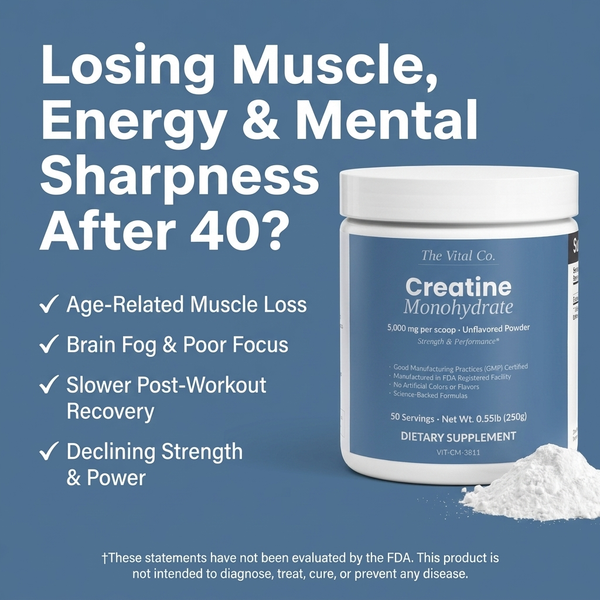
Pure creatine monohydrate powder, 50 servings. Made in the USA from globally sourced ingredients.
Shop Now — $33.90 →
Frequently Asked Questions
Does creatine actually reach the brain?
Will creatine make me smarter?
The evidence does not support creatine as a general cognitive enhancer in well-rested, well-nourished adults. It may offer benefits under conditions of metabolic stress, such as sleep deprivation, or in populations with lower baseline creatine stores. Claims that creatine reliably boosts intelligence in the general population go beyond what current human trials demonstrate.
How much creatine should I take for brain health?
Most cognitive trials have used either 5 g/day (maintenance) or 20 g/day (loading or short-term). The optimal dose for brain-specific effects has not been established. The standard 3–5 g/day creatine monohydrate is a reasonable starting point, as it aligns with the general supplementation evidence base.
Is creatine monohydrate the best form?
Creatine monohydrate is the form used in the vast majority of clinical research — both for muscle and brain outcomes. No other form (HCl, buffered, ethyl ester) has demonstrated superiority in human trials.[12]
Are there risks to supplementing creatine long-term?
Based on the available evidence, long-term creatine monohydrate use at recommended doses is considered safe for healthy adults. The ISSN has reviewed data on supplementation periods of up to five years without identifying adverse effects.[12] Individuals with kidney disease should consult their physician first.
Does the EFSA support creatine for cognitive function?
No. In 2024, EFSA concluded that a cause-and-effect relationship between creatine and improved cognitive function had not been established.[3] This does not mean creatine has no effect — it means the current evidence did not meet EFSA's threshold for an approved health claim.
References
- Dechent P, Pouwels PJW, Wilken B, Hanefeld F, Frahm J. Increase of total creatine in human brain after oral supplementation of creatine-monohydrate. American Journal of Physiology-Regulatory, Integrative and Comparative Physiology. 1999;277(3):R698-R704. doi:10.1152/ajpregu.1999.277.3.R698
- Roschel H, Gualano B, Ostojic SM, Rawson ES. Creatine Supplementation and Brain Health. Nutrients. 2021;13(2):586. doi:10.3390/nu13020586
- EFSA Panel on Nutrition. Creatine and improvement of cognitive function: evaluation of a health claim. EFSA Journal. 2024;22(12):e9100. doi:10.2903/j.efsa.2024.9100
- Forbes SC, Cordingley DM, Cornish SM, et al. Effects of Creatine Supplementation on Brain Function and Health. Nutrients. 2022;14(5):921. doi:10.3390/nu14050921
- Rae C, Digney AL, McEwan SR, Bates TC. Oral Creatine Monohydrate Supplementation Improves Brain Performance. Proceedings of the Royal Society B. 2003;270(1529):2147-2150. doi:10.1098/rspb.2003.2492
- Dolan E, Gualano B, Rawson ES. Beyond Muscle: The Effects of Creatine Supplementation on Brain Creatine, Cognitive Processing, and Traumatic Brain Injury. European Journal of Sport Science. 2019;19(1):1-14. doi:10.1080/17461391.2018.1500644
- Sakellaris G, Kotsiou M, Tamiolaki M, et al. Prevention of Complications Related to Traumatic Brain Injury in Children and Adolescents with Creatine Administration. Journal of Trauma. 2006;61(2):322-329. doi:10.1097/01.ta.0000230269.46108.d5
- Sullivan PG, Geiger JD, Mattson MP, Bhatt P. Dietary Supplement Creatine Protects against Traumatic Brain Injury. Annals of Neurology. 2000;48(5):723-729. doi:10.1002/1531-8249(200011)48:5<723::AID-ANA5>3.0.CO;2-W
- McMorris T, Harris RC, Swain J, et al. Effect of Creatine Supplementation and Sleep Deprivation on Cognitive and Psychomotor Performance. Psychopharmacology. 2006;185(1):93-103. doi:10.1007/s00213-005-0269-z
- Prokopidis K, Giannos P, Troesch B, et al. The Effects of Creatine Supplementation on Cognitive Function in Adults: A Systematic Review and Meta-Analysis. Frontiers in Nutrition. 2024;11:1424972. doi:10.3389/fnut.2024.1424972
- Dean PJA, Arikan G, Opitz B, Sterr A. Potential for Use of Creatine Supplementation Following Mild Traumatic Brain Injury. Concussion. 2017;2(2):CNC34. doi:10.2217/cnc-2016-0016
- Kreider RB, Kalman DS, Antonio J, et al. International Society of Sports Nutrition Position Stand: Safety and Efficacy of Creatine Supplementation in Exercise, Sport, and Medicine. Journal of the International Society of Sports Nutrition. 2017;14:18. doi:10.1186/s12970-017-0173-z