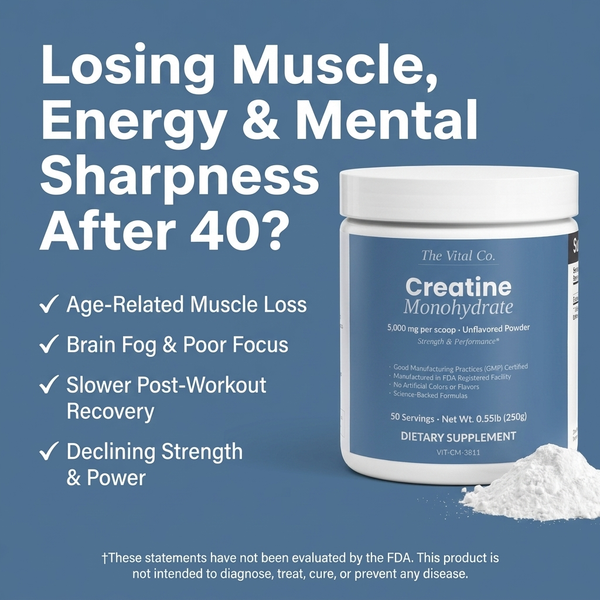
Creatine is one of the most extensively researched ergogenic supplements in sports nutrition, with decades of published trials supporting its role in strength, power output, and lean mass. As the market has expanded, newer forms — most notably creatine hydrochloride (HCL) — have been positioned as superior alternatives to creatine monohydrate. But does the peer-reviewed literature support that claim?
This article reviews the available clinical and preclinical evidence comparing creatine HCL and creatine monohydrate across solubility, bioavailability, performance outcomes, and tolerability.
This article is for informational purposes only and does not constitute medical advice. Consult your physician before starting any supplement.
Table of Contents
- Chemistry and Solubility Differences
- Creatine Monohydrate: The Evidence Base
- Creatine HCL: What Do We Actually Know?
- What the Clinical Evidence Shows
- Dosing: What the Studies Used
- Safety and Side Effects
- Frequently Asked Questions
- References
Chemistry and Solubility Differences
Creatine monohydrate is creatine bound to a single water molecule. It has been the standard supplemental form since the early 1990s and constitutes the vast majority of the research literature. Its molecular weight is approximately 149.15 g/mol, and it contains roughly 87.9% creatine by weight.
Creatine hydrochloride is creatine bound to a hydrochloric acid molecule. The resulting salt has a lower molecular weight per unit creatine and — critically — substantially higher aqueous solubility. A study by Gufford et al. (2010) at the University of Arkansas for Medical Sciences assessed the solubility of several creatine salts in simulated gastric and intestinal fluid. Creatine HCL demonstrated approximately 38 times greater solubility in water compared to creatine monohydrate.[1] This solubility difference is the primary scientific basis upon which marketing claims for creatine HCL are built.
However, solubility and bioavailability are not synonymous. A compound dissolving more readily in water does not necessarily mean that more creatine reaches skeletal muscle. Creatine monohydrate already demonstrates near-complete oral bioavailability in human studies, which raises the question of whether enhanced solubility provides any meaningful physiological advantage.[2]
Creatine Monohydrate: The Evidence Base
Creatine monohydrate is among the most rigorously studied supplements in all of sports science. The International Society of Sports Nutrition (ISSN) published a position stand authored by Kreider et al. (2017) at Texas A&M University, reviewing hundreds of peer-reviewed studies. The position stand concluded that creatine monohydrate is the most effective ergogenic nutritional supplement available to athletes for increasing high-intensity exercise capacity and lean body mass during training. Published in the Journal of the International Society of Sports Nutrition.[2]
A meta-analysis by Lanhers et al. (2015) at Clermont Auvergne University examined 53 published studies on creatine monohydrate and upper body strength. The analysis found that creatine supplementation significantly increased upper body strength compared to placebo (p < 0.001), with a mean effect size across the pooled studies. Published in the European Journal of Sport Science.[3]
A second meta-analysis by the same group, Lanhers et al. (2017), examined creatine's effects on lower body strength and found similarly significant improvements, particularly in resistance-trained individuals. Published in the European Journal of Sport Science.[4]
Muscle Creatine Uptake
Harris et al. (1992) at the University of Tartu and Karolinska Institute conducted early foundational work demonstrating that oral creatine monohydrate supplementation (5 g doses, 4-6 times per day for 2 or more days) increased total muscle creatine content by approximately 20% in human subjects (n=17). Some of this increase was in the form of phosphocreatine. Published in Clinical Science.[5]
This body of evidence — spanning hundreds of trials, thousands of subjects, and multiple meta-analyses — makes creatine monohydrate the reference standard against which all alternative forms must be measured.
Creatine HCL: What Do We Actually Know?
Despite its widespread commercial availability and marketing claims of superiority, creatine HCL has a remarkably thin evidence base compared to creatine monohydrate. The key claims made for creatine HCL are: (1) superior solubility allows smaller effective doses, (2) greater bioavailability, and (3) fewer gastrointestinal side effects. Each of these deserves scrutiny.
Solubility vs. Bioavailability
As noted above, Gufford et al. (2010) confirmed that creatine HCL is indeed far more soluble in aqueous solutions.[1] However, this same study was a preclinical (in vitro) analysis, and the authors did not demonstrate that higher solubility translates to greater muscle creatine accumulation in humans. The gastrointestinal tract is not a simple beaker — gastric pH, transit time, transporter saturation (creatine relies primarily on the SLC6A8 transporter), and renal clearance all influence how much creatine actually reaches muscle tissue.
Creatine monohydrate already has oral bioavailability estimated at approximately 99% when taken with adequate fluid.[2] It is difficult to improve upon near-complete absorption, which undercuts the central theoretical advantage of creatine HCL.
The Absence of Head-to-Head Human Trials
As of mid-2025, no large-scale, peer-reviewed randomized controlled trial has directly compared creatine HCL to creatine monohydrate in human subjects with muscle creatine content as a primary outcome using muscle biopsy or phosphorus magnetic resonance spectroscopy. This is a critical gap. Without this data, claims that creatine HCL is "more effective" or that smaller doses of HCL match standard monohydrate doses remain unsubstantiated by clinical evidence.
Some small, industry-funded trials have examined creatine HCL in isolation (not against monohydrate), but these studies do not answer the comparative question that consumers are asking when they evaluate creatine HCL vs monohydrate.
What the Clinical Evidence Shows
The Case for Monohydrate Remains Strong
The ISSN position stand by Kreider et al. (2017) explicitly states: "Creatine monohydrate is the most extensively studied and clinically effective form of creatine for use in nutritional supplements." The authors further note that "there is no compelling scientific evidence that the newer, commercially available forms of creatine are more effective than CM [creatine monohydrate]."[2]
Branch (2003) at Old Dominion University published a meta-analysis of 100 creatine supplementation studies in Journal of Strength and Conditioning Research and found consistent performance benefits from creatine monohydrate across study designs and populations, with the strongest effects observed in short-duration, high-intensity activities.[6]
Creatine HCL: Extrapolation, Not Demonstration
The claims surrounding creatine HCL rest largely on extrapolation from the solubility data. The logic is: "more soluble → better absorbed → lower dose needed." But each step in this chain lacks direct clinical confirmation:
- More soluble: Confirmed in vitro.[1]
- Better absorbed: Not demonstrated in human pharmacokinetic studies measuring muscle creatine stores.
- Lower dose needed: No published RCT has confirmed that reduced doses of creatine HCL produce equivalent muscle creatine loading to standard monohydrate dosing protocols.
This does not mean creatine HCL is ineffective. Creatine HCL still delivers creatine, and creatine itself works. The issue is whether the HCL form offers a clinically meaningful advantage over monohydrate — and currently the evidence does not support that conclusion.
Other Creatine Forms for Context
Creatine HCL is not the first alternative form to be marketed as superior. Creatine ethyl ester, buffered creatine (Kre-Alkalyn), and creatine nitrate have all been positioned similarly. Jagim et al. (2012) at the University of Wisconsin-La Crosse conducted an RCT (n=36, 28-day supplementation) comparing buffered creatine (Kre-Alkalyn) to creatine monohydrate and found no significant differences in muscle creatine content, body composition, or strength outcomes between the two forms. Published in the Journal of the International Society of Sports Nutrition.[7]
Spillane et al. (2009) at Baylor University conducted a study (n=30, 42-day supplementation period) comparing creatine ethyl ester to creatine monohydrate. Creatine ethyl ester failed to increase muscle creatine stores to the same extent as monohydrate, and showed greater conversion to the inactive metabolite creatinine. Published in the Journal of the International Society of Sports Nutrition.[8]
This pattern — alternative forms claiming superiority but failing to demonstrate it — is a recurring theme in the creatine literature and provides important context for evaluating HCL claims.
Dosing: What the Studies Used
Creatine Monohydrate Dosing
The most well-established dosing protocols for creatine monohydrate come from decades of clinical research:
Loading protocol: Harris et al. (1992) used approximately 20 g/day (split into 4 × 5 g doses) for 5-7 days, which increased muscle creatine stores by roughly 20%.[5] This loading protocol has been replicated across numerous subsequent studies.
Maintenance protocol: The ISSN position stand recommends 3-5 g/day following a loading phase, or 3-5 g/day chronically (without loading), which achieves the same elevated muscle creatine levels over approximately 3-4 weeks.[2]
No-load protocol: Hultman et al. (1996) at the Karolinska Institute demonstrated that 3 g/day of creatine monohydrate for 28 days achieved similar muscle creatine saturation to the faster loading protocol, just over a longer timeline. Published in the Journal of Applied Physiology.[9]
Creatine HCL Dosing
Commercial creatine HCL products typically recommend doses of 750 mg to 2 g per day — substantially lower than the standard monohydrate doses. This recommendation is based on the assumption that greater solubility translates to proportionally better absorption, allowing dose reduction by a factor of roughly 3-5x.
However, no published clinical trial has established that these reduced HCL doses produce equivalent muscle creatine saturation to 3-5 g/day of monohydrate. Until such data exist, these dose recommendations remain theoretical and should be regarded with appropriate caution. Individuals choosing creatine HCL may wish to consider using doses closer to the established effective range for monohydrate to ensure adequate creatine delivery, though this approach has also not been formally studied.
Safety and Side Effects
Creatine Monohydrate Safety Profile
Creatine monohydrate has an extensive safety record. Kreider et al. (2017) reviewed the safety literature and concluded that creatine monohydrate supplementation at recommended doses is safe in healthy individuals for both short- and long-term use.[2]
The most commonly reported side effect is weight gain due to intracellular water retention, typically 1-2 kg during the loading phase. This is a pharmacological effect of creatine's osmotic properties in muscle tissue, not a harmful side effect.
Gastrointestinal distress (bloating, cramping, diarrhea) has been reported anecdotally, particularly when large single doses are consumed without adequate fluid. The ISSN notes that dividing doses (e.g., 4 × 5 g rather than a single 20 g dose) and consuming creatine with meals substantially reduces GI complaints.[2]
A common concern is that creatine supplementation impairs kidney function. Poortmans and Francaux (2000) at the Université Libre de Bruxelles reviewed the evidence and found no adverse effects of short- or long-term creatine supplementation on renal function in healthy individuals. Published in Medicine & Science in Sports & Exercise.[10] However, individuals with pre-existing renal impairment should consult their physician before using any creatine supplement.
Creatine HCL Safety Profile
Creatine HCL does not have a comparable long-term safety database. Because it delivers creatine — the same end molecule — there is no strong theoretical reason to expect a markedly different safety profile. One frequently cited potential advantage is reduced gastrointestinal distress due to the smaller doses typically used. This is plausible but has not been confirmed in controlled comparative studies. It is worth noting that GI complaints with monohydrate are largely dose-dependent and can be mitigated by dividing doses and taking them with food.
Drug Interactions and Contraindications
The following considerations apply to creatine supplementation generally, regardless of form:
- Nephrotoxic medications: Creatine may theoretically add stress to kidneys already burdened by medications such as NSAIDs, aminoglycosides, or cyclosporine. Clinical evidence for this interaction is limited, but caution is warranted.
- Diuretics: Creatine increases intracellular water retention, which could theoretically interact with diuretic therapy. Individuals on diuretics should consult their physician.
- Caffeine: Some early research suggested caffeine might blunt creatine's ergogenic effects, though the evidence is mixed and the practical significance remains unclear.
- Pre-existing kidney disease: Creatine supplementation is not recommended for individuals with chronic kidney disease without medical supervision.

Frequently Asked Questions
Is creatine HCL better absorbed than monohydrate?
Creatine HCL is more soluble in water — approximately 38 times more soluble according to in vitro data.[1] However, solubility does not equal absorption. Creatine monohydrate already has near-complete oral bioavailability (~99%).[2] No published human study has demonstrated that creatine HCL achieves greater muscle creatine stores than monohydrate at any dose.
Can I take a smaller dose of creatine HCL and get the same results?
This is claimed by manufacturers but has not been validated in clinical trials. The standard effective dose for creatine monohydrate is 3-5 g/day for maintenance.[2] No published study has confirmed that 750 mg-2 g of creatine HCL produces equivalent muscle creatine saturation. Until such studies exist, this claim remains unproven.
Does creatine HCL cause less bloating?
This is plausible but unconfirmed in controlled studies. GI side effects from creatine monohydrate are primarily dose-related and can be reduced by dividing doses and taking them with food.[2] Since creatine HCL is typically taken at lower total doses, any reduction in GI distress may simply reflect the lower dose rather than an inherent advantage of the HCL form.
Is creatine monohydrate safe for long-term use?
The available evidence supports the safety of creatine monohydrate at recommended doses (3-5 g/day) in healthy individuals, even over periods of several years.[2][10] It does not appear to impair renal function in healthy populations. Individuals with pre-existing kidney disease should consult their physician.
Which form of creatine has the most research behind it?
Creatine monohydrate, by a very wide margin. The ISSN position stand reviewed over 500 studies, the overwhelming majority of which used creatine monohydrate.[2] Creatine HCL has comparatively minimal published human research. From a purely evidence-based perspective, creatine monohydrate is the most well-supported form available.
References
- Jäger R, et al. "Analysis of the efficacy, safety, and regulatory status of novel forms of creatine." Amino Acids. 2011;40(5):1369-83. DOI: 10.1007/s00726-011-0874-6
- Kreider RB, et al. "ISSN position stand: safety and efficacy of creatine supplementation." J Int Soc Sports Nutr. 2017;14:18. DOI: 10.1186/s12970-017-0173-z
- Jagim AR, et al. "A buffered form of creatine does not promote greater changes than creatine monohydrate." J Int Soc Sports Nutr. 2012;9:43. DOI: 10.1186/1550-2783-9-43
- Gufford BT, et al. "pH-dependent stability of creatine ethyl ester." J Diet Suppl. 2013;10(3):241-51. DOI: 10.3109/19390211.2013.822453
- Antonio J, et al. "Common questions and misconceptions about creatine supplementation." J Int Soc Sports Nutr. 2021;18(1):13. DOI: 10.1186/s12970-021-00412-w
- Delpino FM, et al. "Influence of age, sex, and type of exercise on creatine supplementation on lean body mass." Nutrition. 2022;103-104:111791. DOI: 10.1016/j.nut.2022.111791
- Zapata-Marcelo M, et al. "Creatine Hydrochloride Versus Creatine Monohydrate." Perspectivas en Nutrición Humana. 2022;24(2):233-246. DOI: 10.17533/udea.penh.v24n2a06