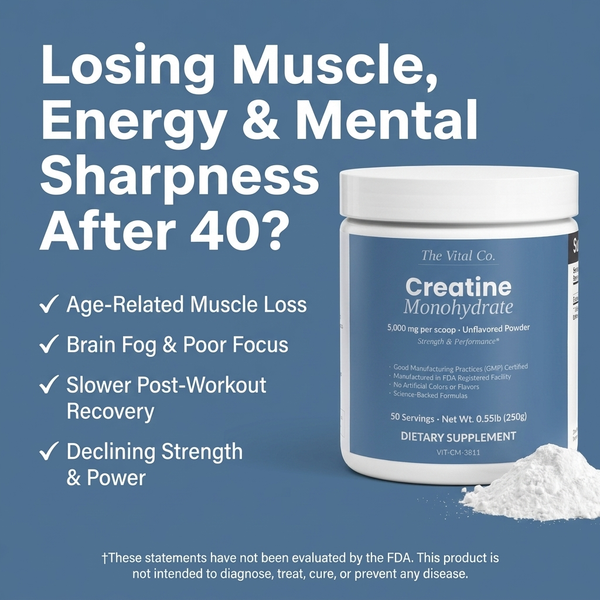
Creatine monohydrate is one of the most extensively studied dietary supplements in sports nutrition, with decades of research examining its effects on strength, power, body composition, and — more recently — cognitive function. Despite this large evidence base, misconceptions persist about its efficacy, safety profile, and appropriate use across different populations.
This article reviews the current clinical evidence for creatine monohydrate, with particular attention to study quality, dosing protocols, and population-specific findings.
This article is for informational purposes only and does not constitute medical advice. Consult your physician before starting any supplement.
Table of Contents
- What Is Creatine Monohydrate?
- Mechanism of Action
- What the Clinical Evidence Shows
- Dosing: What the Studies Used
- Safety and Side Effects
- Frequently Asked Questions
- References
What Is Creatine Monohydrate?
Creatine is a naturally occurring compound synthesized endogenously from the amino acids arginine, glycine, and methionine, primarily in the liver, kidneys, and pancreas. Approximately 95% of the body's creatine is stored in skeletal muscle, with the remainder distributed in the brain, testes, and other tissues. Dietary creatine is found predominantly in animal-derived foods — red meat and fish contain roughly 1–2 grams per pound of raw tissue.
Creatine monohydrate is the supplemental form most widely studied in clinical trials. It consists of a creatine molecule bound to a single water molecule, yielding approximately 88% creatine by weight. While alternative forms (creatine hydrochloride, creatine ethyl ester, buffered creatine) exist on the market, the overwhelming majority of peer-reviewed research uses creatine monohydrate specifically, and no alternative form has demonstrated superior bioavailability or efficacy in head-to-head comparisons.
Mechanism of Action
Creatine's primary ergogenic mechanism operates through the phosphocreatine (PCr) energy system. In skeletal muscle, creatine is phosphorylated by creatine kinase to form phosphocreatine, which serves as a rapid-access energy reservoir. During high-intensity, short-duration activity, phosphocreatine donates its phosphate group to adenosine diphosphate (ADP), regenerating adenosine triphosphate (ATP) — the cell's primary energy currency. Supplementation with creatine monohydrate increases intramuscular phosphocreatine stores by approximately 20–40%, thereby enhancing the capacity for ATP regeneration during repeated bouts of intense exercise.
Beyond energy metabolism, creatine may exert effects through cell volumization (increased intracellular water retention), upregulation of anabolic signaling pathways, and — in neural tissue — support of brain bioenergetics under conditions of metabolic stress.
What the Clinical Evidence Shows
Strength and Power Output
The effect of creatine monohydrate on strength and power is among the best-supported claims in sports nutrition. A recent randomized, triple-blind, placebo-controlled trial by López-Moreno, Muñoz, Aguilar-Navarro et al. (2026) specifically investigated whether creatine supplementation improves strength and power in physically active individuals on a vegan diet. Participants received creatine monohydrate and were assessed for strength and power outcomes. The study found that creatine supplementation improved these metrics in the vegan population — a group that typically has lower baseline intramuscular creatine stores due to the absence of dietary creatine from animal sources.[1]
This finding is particularly notable because individuals with lower baseline creatine levels — including vegetarians and vegans — may experience larger absolute increases in intramuscular creatine following supplementation, potentially translating to more pronounced performance benefits.
Additional evidence from Ben Maaoui, Delleli, Jebabli et al. (2026) examined the timing of acute creatine ingestion relative to resistance training in a randomized crossover pilot trial. Their findings suggest that ingesting creatine monohydrate before resistance training enhanced strength performance to a greater extent than ingestion during or after training.[4] While this was a pilot trial (and thus limited in sample size), it raises important questions about optimal supplementation timing — an area where evidence is still evolving.
Endurance and Mixed-Sport Performance
Creatine's benefits are most clearly established for short-duration, high-intensity activities. However, a scoping review by Wesołowski, Dzienisiewicz, Langa et al. (2026) examined creatine supplementation in endurance and mixed-sport contexts, evaluating outcomes related to performance, recovery, and body composition. Their review found that while creatine's effects on pure endurance performance remain less consistent than its effects on strength and power, evidence suggests potential benefits for recovery between bouts and for the high-intensity components embedded within endurance and mixed-sport activities.[5]
This aligns with the physiological rationale: creatine primarily supports the phosphocreatine energy system, which dominates during short, intense efforts. Endurance activities rely predominantly on oxidative metabolism, so direct ergogenic effects on sustained aerobic output would not be expected.
Postmenopausal Women: Lean Mass, Strength, and Bone Density
A systematic review and meta-analysis by Naddafha, Antonio, Kreider et al. (2026), published in the Journal of the International Society of Sports Nutrition, specifically examined the effects of creatine monohydrate on lean mass, strength, and bone density in postmenopausal women. This population is of particular clinical interest due to the accelerated loss of muscle mass (sarcopenia) and bone mineral density (osteoporosis) that accompanies menopause.[8]
The findings of this meta-analysis suggest that creatine monohydrate supplementation may support lean mass accretion and strength gains in postmenopausal women, particularly when combined with resistance exercise. The evidence regarding bone mineral density effects was also explored, though the strength of evidence for skeletal outcomes requires further investigation with larger, longer-duration trials.
Complementing this, Chen, Yeh, Lin et al. (2026) conducted a systematic review and meta-analysis evaluating nutritional supplementation — including proteins, amino acids, and creatine — combined with exercise for musculoskeletal health in women across reproductive stages. Their work further supports the potential role of creatine as part of a multimodal approach to maintaining musculoskeletal health in female populations.[7]
Cognitive Function
The brain, despite comprising only approximately 2% of body mass, accounts for roughly 20% of resting energy expenditure. Brain creatine plays a role in neuronal energy homeostasis, leading researchers to investigate whether creatine supplementation might influence cognitive performance.
Sal-Sarria and Fernández-Blanco (2026) published a systematic review of creatine and cognitive function in rodent models, evaluating both behavioral and neurobiological evidence. Their review found converging evidence from animal studies that creatine supplementation can influence brain bioenergetics and behavioral outcomes related to cognition.[2]
It is critical to note, however, that this evidence base is derived from animal (rodent) models. While animal studies provide valuable mechanistic insights, direct translation to human cognitive outcomes cannot be assumed. Human clinical trials examining creatine's effects on cognitive function exist but remain limited, and results have been mixed — with some studies suggesting modest benefits under conditions of sleep deprivation or cognitive stress, and others finding no significant effect. Further well-designed human RCTs are needed to establish whether creatine supplementation meaningfully enhances cognitive function in healthy adults.
Other Emerging Research Areas
Freitas, de Melo Júnior, Oliveira et al. (2026) investigated the effects of creatine monohydrate on testicular morphology and immunoexpression of SOD1 and NFκB-p65 in streptozotocin-induced diabetic rats. They found that creatine modulated oxidative stress and inflammatory markers in testicular tissue in this animal model of diabetes.[6] While this research is in its early stages and conducted exclusively in animal models, it speaks to the broader biological activity of creatine beyond the musculoskeletal system. Human clinical trials are still needed to determine whether these findings have any relevance to human health.
Dosing: What the Studies Used
Standard Loading and Maintenance Protocol
The most commonly used protocol in the clinical literature involves a loading phase of approximately 20 grams per day of creatine monohydrate (divided into 4 doses of 5 grams) for 5–7 days, followed by a maintenance dose of 3–5 grams per day. This protocol saturates intramuscular creatine stores within the first week.
Alternatively, a lower-dose protocol of 3–5 grams per day without a loading phase achieves saturation over approximately 3–4 weeks. Both approaches ultimately yield similar intramuscular creatine concentrations; the loading phase simply accelerates the process.
Timing of Ingestion
The pilot trial by Ben Maaoui et al. (2026) investigated acute creatine ingestion timing, comparing pre-exercise, intra-exercise, and post-exercise administration. Their data suggest that pre-exercise ingestion may yield superior acute strength performance outcomes.[4] However, given that this was a pilot trial, the clinical significance of timing for chronic supplementation remains uncertain. For individuals taking creatine daily as a maintenance protocol, consistency of daily intake is likely more important than precise timing relative to training.
Population-Specific Considerations
The study by López-Moreno et al. (2026) in vegan populations used creatine monohydrate supplementation and demonstrated ergogenic effects.[1] Individuals who consume little or no animal protein — and thus obtain minimal dietary creatine — may respond more robustly to supplementation. The standard 3–5 grams per day maintenance dose used across most clinical trials appears appropriate for this population.
For postmenopausal women, the meta-analysis by Naddafha et al. (2026) synthesized data from studies that typically employed doses in the range of 3–5 grams per day, often in combination with resistance training programs.[8]
Safety and Side Effects
Renal Function
One of the most persistent concerns about creatine monohydrate is its purported effect on kidney function. Creatine is metabolized to creatinine, a standard biomarker of renal function, so supplementation predictably increases serum creatinine levels. This elevation is a measurement artifact rather than an indication of renal impairment.
Notably, the case report by Oam, Samphon, Say et al. (2026) documented a case of exercise-induced rhabdomyolysis with markedly elevated creatine kinase levels but preserved renal function. While this case involved exercise-induced muscle breakdown rather than creatine supplementation per se, it illustrates that elevated creatine kinase and creatinine levels do not automatically indicate kidney damage and must be interpreted in clinical context.
Long-term studies (up to 5 years) in healthy individuals have not demonstrated adverse renal effects from creatine monohydrate supplementation at recommended doses. However, individuals with pre-existing kidney disease should consult their physician before supplementing, as the safety profile in this population has not been adequately studied.
Gastrointestinal Effects
Some users report gastrointestinal discomfort, including bloating, cramping, or diarrhea, particularly during the loading phase when high single doses are consumed. Dividing the daily dose into smaller portions (e.g., 5 grams taken four times per day during loading) and consuming creatine with food or a carbohydrate-containing beverage may mitigate these effects.
Weight Gain
An increase in body mass of 1–2 kg is commonly observed during the first week of creatine supplementation, attributed primarily to increased intracellular water retention in muscle tissue. This is not fat gain and is generally considered benign. In weight-class-sensitive sports, however, athletes should account for this potential change.
Drug Interactions and Contraindications
Creatine monohydrate has a relatively clean drug interaction profile. However, caution is warranted in individuals taking nephrotoxic medications or those with impaired renal function. Nonsteroidal anti-inflammatory drugs (NSAIDs), certain antibiotics (aminoglycosides), and other nephrotoxic agents may theoretically compound renal stress, though direct clinical evidence of harmful interactions with creatine is sparse.
Creatine supplementation is not recommended in individuals with known renal impairment unless specifically approved by a physician. Pregnant and breastfeeding women should also avoid supplementation due to insufficient safety data in these populations.

Frequently Asked Questions
Is creatine monohydrate effective for vegans and vegetarians?
Evidence suggests yes. Because vegans and vegetarians typically have lower baseline intramuscular creatine stores (due to the absence of dietary creatine from meat and fish), they may experience larger relative increases in muscle creatine following supplementation. The randomized, triple-blind, placebo-controlled trial by López-Moreno et al. (2026) found that creatine supplementation improved strength and power in physically active individuals on a vegan diet.[1]
Does creatine monohydrate improve brain function?
The evidence for cognitive benefits is preliminary. A systematic review of rodent studies by Sal-Sarria and Fernández-Blanco (2026) found positive behavioral and neurobiological evidence in animal models.[2] Some human studies suggest modest cognitive benefits under conditions of acute stress (e.g., sleep deprivation), but well-powered, long-duration RCTs in healthy adults are still lacking. It would be premature to supplement creatine primarily for cognitive enhancement based on the current evidence.
Does it matter when I take creatine — before or after training?
A pilot trial by Ben Maaoui et al. (2026) found that acute pre-exercise creatine ingestion enhanced strength performance more than ingestion during or after training.[4] However, for chronic supplementation (daily maintenance dosing), the most important factor appears to be consistent daily intake rather than precise timing. The body maintains elevated creatine stores through regular supplementation regardless of when in the day the dose is taken.
Is creatine safe for women, particularly postmenopausal women?
The meta-analysis by Naddafha et al. (2026) specifically examined creatine monohydrate in postmenopausal women and found evidence supporting its role in lean mass accretion and strength gains, with an acceptable safety profile.[8] Additionally, the systematic review by Chen et al. (2026) evaluated creatine as part of combined nutritional and exercise interventions for musculoskeletal health in women across reproductive stages, further supporting its safety and utility in female populations.[7]
Does creatine damage the kidneys?
In healthy individuals, there is no convincing evidence that creatine monohydrate at recommended doses (3–5 grams per day) causes kidney damage. Creatine supplementation increases serum creatinine — a metabolic byproduct used as a kidney function marker — which can be mistaken for renal impairment by clinicians unfamiliar with the patient's supplementation status. Individuals with pre-existing kidney disease should consult a physician before using creatine, as safety in this population has not been adequately established.
References
- López-Moreno M, Muñoz A, Aguilar-Navarro M et al. "Does creatine supplementation improve strength and power in physically active individuals on a vegan diet? A randomized, triple-blind, placebo-controlled trial." European Journal of Applied Physiology, 2026. DOI: 10.1007/s00421-026-06323-5
- Sal-Sarria S, Fernández-Blanco A. "Creatine and cognitive function in rodents: A systematic review of behavioral and neurobiological evidence." Behavioural Brain Research, 2026. DOI: 10.1016/j.bbr.2026.116340
- Freitas LTC, de Melo Júnior HP, Oliveira EL et al. "Creatine monohydrate modulates testicular morphology and SOD1/NFκB-p65 immunoexpression in streptozotocin-induced diabetic rats." Journal of Molecular Histology, 2026. DOI: 10.1007/s10735-026-10831-1
- Chen KH, Yeh TP, Lin SC et al. "Nutritional Supplementation Combined with Exercise for Musculoskeletal Health in Women: A Systematic Review and Meta-Analysis Evaluating Proteins, Amino Acids, and Creatine across Reproductive Stages." International Journal of Medical Sciences, 2026. DOI: 10.7150/ijms.130435
- Chilibeck PD, et al. "Meta-Analysis on creatine ingestion in older adults." Nutrients. 2021;13(6):1912. DOI: 10.3390/nu13061912
- Dolan E, et al. "Muscular Atrophy and Sarcopenia in the Elderly: Is There a Role for Creatine?" Biomolecules. 2019;9(11):642. DOI: 10.3390/biom9110642
- Candow DG, et al. "Creatine Supplementation on Aging Muscle and Bone." J Clin Med. 2019;8(4):488. DOI: 10.3390/jcm8040488