"Do digestive enzymes work?" has no single answer, because "digestive enzymes" covers very different things: prescription pancreatic enzymes for people whose pancreas cannot keep up, single enzymes aimed at one food (lactase for dairy, alpha-galactosidase for beans), and over-the-counter blends taken for everyday indigestion. The evidence is strongest at the medical end and thinner, but not absent, at the everyday end. This guide walks through each, using only published trials and reviews.
This article is for general education and is not medical advice. Talk to your doctor before starting a supplement, and get ongoing digestive symptoms checked rather than self-treating them.
1. When the pancreas is not producing enough: strong evidence, prescription treatment
Exocrine pancreatic insufficiency (EPI) means the pancreas does not release enough digestive enzymes, so fat in particular is poorly absorbed. It is treated with prescription pancreatic enzyme replacement therapy (PERT), not with supplements. A systematic review and meta-analysis by de la Iglesia-García and colleagues in Gut pooled randomised trials in chronic pancreatitis and found that PERT improved fat absorption compared with both baseline and placebo, and reduced faecal fat and abdominal pain, without significant adverse events.[1]
Pancreatic function also changes with age. A systematic review by Löhr and colleagues reports that pancreatic exocrine function declines in healthy older people, and estimates that around 5% of people over 70 and 10% of people over 80 have pancreatic exocrine insufficiency by faecal elastase testing. The authors note that whether this age-related decline warrants treatment is still an open question.[2]
If you have greasy or pale stools, unexplained weight loss or chronic diarrhoea, that needs a medical work-up. An over-the-counter enzyme is not a substitute for diagnosis or for prescribed PERT.
2. When one food is the problem: targeted enzymes
Lactase for dairy
In a randomised, double-blind, placebo-controlled crossover trial in 47 adults with breath-test-confirmed lactose intolerance, Baijal and colleagues found that lactase tablets improved symptom scores and lowered breath hydrogen compared with placebo.[3] A systematic review by Shaukat and colleagues adds context: most people with presumed lactose intolerance tolerate 12 to 15 g of lactose, and the review called for more studies on treatment effectiveness.[4]
Alpha-galactosidase for beans
Di Stefano and colleagues gave eight healthy volunteers a 420 g bean meal with alpha-galactosidase or placebo; the higher dose (1,200 GalU) reduced breath hydrogen and flatulence severity, and both doses tested reduced total symptom scores.[5] In a 12-week trial in 125 people with IBS, however, Hillilä and colleagues found no evidence to support routine alpha-galactosidase use.[6] So it is best viewed as a tool for gas from specific foods, not a general bloating fix.
3. Everyday indigestion: multi-enzyme blends
The question most people are really asking is whether a broad enzyme blend helps ordinary post-meal discomfort. Several randomised, placebo-controlled trials in functional dyspepsia (recurring indigestion without an identifiable cause) have reported benefits:
- Ullah and colleagues (2023): 120 adults took a fungal multi-enzyme blend or placebo for two months; the enzyme group improved on dyspepsia-related quality of life, pain severity and sleep quality, without side effects.[7]
- Majeed and colleagues (2018): 40 patients took a multi-enzyme complex or placebo for 60 days; the enzyme group improved on all dyspepsia measures used, with no product-related adverse events.[8]
- Ran and colleagues (2009): in a crossover trial in 151 patients, two weeks of an enzyme preparation reduced dyspepsia symptom severity compared with placebo, including abdominal distension, belching and abdominal pain.[9]
These are encouraging but limited: each tested one specific formula, trials were short, and they enrolled people with diagnosed functional dyspepsia rather than the general population. The fair summary is that enzyme blends may support comfortable digestion for some people, and were well tolerated in these trials, but they are not proven for everyone.
So who is most likely to notice a difference?
- People whose symptoms follow specific foods, such as dairy or beans, where a matching enzyme has been tested.
- People with recurring indigestion after meals, in whom enzyme blends have been tested in placebo-controlled trials.
- Not people with undiagnosed red-flag symptoms, who should see a doctor first, and not people with EPI, who need prescription treatment.
Practical tips
- Timing: enzymes act on the food they meet, so take them at the start of a meal.
- Read the label for activity units: enzyme strength is expressed in activity units (for example LACU for lactase or GALU for alpha-galactosidase), which tell you more than milligrams.
- Give it a fair, simple test: try it with the meals that bother you and keep a short symptom note, rather than changing several things at once.
Where The Vital Co. fits
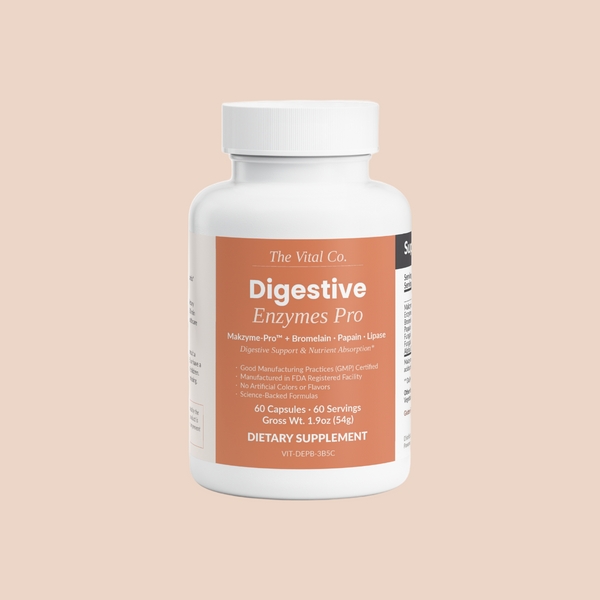
Vital Digestive Enzyme Pro Blend prints each enzyme activity on its label: the Makzyme-Pro™ protease blend (2,500 HUT), bromelain (90 GDU), papain (2,670 TU), fungal lipase (1,500 FIP), lactase (600 LACU) and alpha-galactosidase (300 GALU), one capsule at the start of a meal. The trials above tested other formulas, not this product, so they show what these enzyme types have been studied for rather than guarantee a result.
The De-Bloat & Digest Stack pairs Vital Digestive Enzyme Pro Blend with Vital Gut Restore, a 13-strain, 20 billion CFU probiotic, for people who want to support both the meal itself and the gut bacteria underneath.
References
- de la Iglesia-García D, et al. Efficacy of pancreatic enzyme replacement therapy in chronic pancreatitis: systematic review and meta-analysis. Gut. 2017. DOI: 10.1136/gutjnl-2016-312529 (PMID 27941156)
- Löhr JM, et al. The ageing pancreas: a systematic review of the evidence and analysis of the consequences. Journal of Internal Medicine. 2018. DOI: 10.1111/joim.12745 (PMID 29474746)
- Baijal R, et al. Effect of lactase on symptoms and hydrogen breath levels in lactose intolerance: A crossover placebo-controlled study. JGH Open. 2021. DOI: 10.1002/jgh3.12463 (PMID 33490624)
- Shaukat A, et al. Systematic review: effective management strategies for lactose intolerance. Annals of Internal Medicine. 2010. DOI: 10.7326/0003-4819-152-12-201006150-00241 (PMID 20404262)
- Di Stefano M, et al. The effect of oral alpha-galactosidase on intestinal gas production and gas-related symptoms. Digestive Diseases and Sciences. 2007. DOI: 10.1007/s10620-006-9296-9 (PMID 17151807)
- Hillilä M, et al. Does oral α-galactosidase relieve irritable bowel symptoms? Scandinavian Journal of Gastroenterology. 2016. DOI: 10.3109/00365521.2015.1063156 (PMID 26133538)
- Ullah H, et al. Efficacy of digestive enzyme supplementation in functional dyspepsia: A monocentric, randomized, double-blind, placebo-controlled, clinical trial. Biomedicine & Pharmacotherapy. 2023. DOI: 10.1016/j.biopha.2023.115858 (PMID 37976892)
- Majeed M, et al. Evaluation of the Safety and Efficacy of a Multienzyme Complex in Patients with Functional Dyspepsia: A Randomized, Double-Blind, Placebo-Controlled Study. Journal of Medicinal Food. 2018. DOI: 10.1089/jmf.2017.4172 (PMID 30156436)
- Ran ZH, et al. The efficacy of Combizym in the treatment of Chinese patients with dyspepsia: a multicenter, randomized, placebo-controlled and cross-over study. Journal of Digestive Diseases. 2009. DOI: 10.1111/j.1751-2980.2008.00361.x (PMID 19236546)