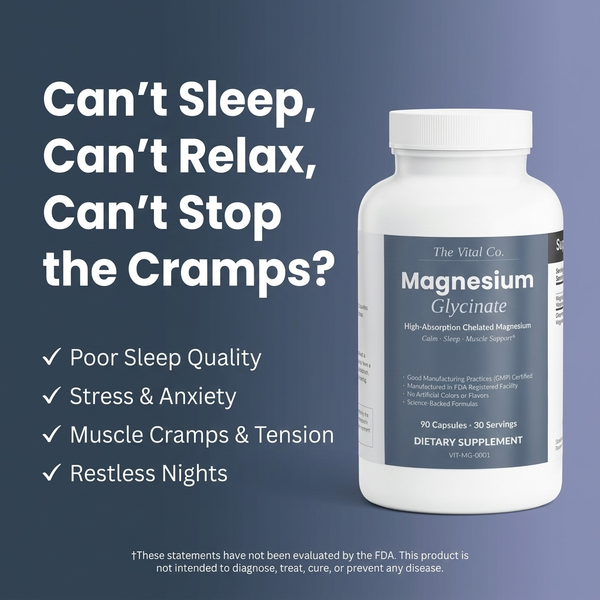
Magnesium is the fourth most abundant mineral in the human body and a cofactor in more than 300 enzymatic reactions. Despite its importance, subclinical magnesium deficiency is remarkably common. This evidence-based review examines what the clinical research shows about magnesium glycinate (bisglycinate): its bioavailability, effects on sleep and stress, dosing, and safety.
This article is for informational purposes only and does not constitute medical advice. Consult your physician before starting any supplement.
How Common Is Magnesium Deficiency?
More common than most people realize. A review published in Open Heart by DiNicolantonio, O'Keefe, and Wilson (2018) found that 10-30% of people in developed countries have subclinical magnesium deficiency based on serum magnesium levels alone. A large cross-sectional study of over 16,000 subjects in Germany found hypomagnesaemia prevalence of 14.5%.
Serum magnesium reflects less than 1% of total body magnesium, because most is stored in bones and soft tissue. Standard blood tests routinely miss deficiency. A separate review in the International Journal of Vitamins and Nutrition Research confirmed that 15-42% of apparently healthy adults have subnormal serum magnesium levels.
Who Is Most at Risk?
- Adults over 40: Absorption decreases and renal excretion increases with age
- People taking certain medications: PPIs, diuretics, and statins can affect magnesium status
- Women during hormonal transitions: A dataset analysis in BMC Medicine found hypomagnesaemia in 34.0% of pregnant women
- People with type 2 diabetes: 14-48% have hypomagnesemia
Not All Magnesium Is Created Equal
Magnesium Oxide
The cheapest form and worst absorbed. Lindberg et al. (1990) in the Journal of the American College of Nutrition found it virtually insoluble in water with roughly 4% bioavailability.
Magnesium Citrate
Substantially better absorption than oxide. Kappeler et al. (2017) in BMC Nutrition demonstrated higher serum magnesium AUC for citrate vs oxide in a randomized crossover study.
Magnesium Glycinate (Bisglycinate)
Chelated magnesium bound to glycine. Schuette et al. (1994) in JPEN found magnesium diglycinate better absorbed than oxide in a double-blind crossover trial. The chelated structure may allow uptake through dipeptide transport pathways. Glycinate also causes fewer GI side effects than oxide or citrate.
Magnesium and Sleep
A 2025 RCT in Nature and Science of Sleep studied 155 adults with poor sleep taking 250 mg magnesium bisglycinate daily. The magnesium group showed significantly greater reduction in Insomnia Severity Index scores vs placebo at Week 4 (p = 0.049). Effect size was small (Cohen's d = 0.2). Greater improvements occurred in participants with lower baseline magnesium intake.
Abbasi et al. (2012) in the Journal of Research in Medical Sciences found significant increases in sleep time (p = 0.002) and sleep efficiency (p = 0.03) with 500 mg magnesium daily for 8 weeks in 46 elderly subjects.
Magnesium and Stress
Boyle et al. (2017) systematically reviewed 18 studies in Nutrients. Finding: evidence is 'suggestive of a beneficial effect on subjective anxiety in anxiety-vulnerable samples.' Magnesium modulates the HPA axis, reducing ACTH and cortisol responses. However, the authors rated overall evidence quality as poor.
Dosing: What the Studies Used
Most bisglycinate-specific research uses 250 mg elemental magnesium per day. NIH RDAs: 400-420 mg/day for men, 310-320 mg/day for women (from all sources).
Safety
The UL for supplemental magnesium is 350 mg/day (supplements only, not food). GI upset is the main side effect, significantly less common with glycinate than oxide or citrate. Hypermagnesemia is rare with healthy kidneys. Take 2+ hours apart from bisphosphonates, tetracyclines, and quinolones.
† These statements have not been evaluated by the FDA. This product is not intended to diagnose, treat, cure, or prevent any disease.
References
- Schuster J, et al. "Magnesium Bisglycinate Supplementation in Healthy Adults Reporting Poor Sleep." Nat Sci Sleep. 2025;17:2027-2040. DOI: 10.2147/NSS.S524348
- Noah L, et al. "Effect of magnesium and vitamin B6 supplementation on mental health and quality of life in stressed healthy adults." Stress Health. 2021;37(5):1000-1009. DOI: 10.1002/smi.3051
- Tarleton EK, et al. "Role of magnesium supplementation in the treatment of depression: A randomized clinical trial." PLoS One. 2017;12(6):e0180067. DOI: 10.1371/journal.pone.0180067
- Chen H-Y, et al. "Magnesium Enhances Exercise Performance via Increasing Glucose Availability." PLoS One. 2014;9(1):e85486. DOI: 10.1371/journal.pone.0085486
- Steward CJ, et al. "One week of magnesium supplementation lowers IL-6, muscle soreness." Eur J Appl Physiol. 2019;119(11-12):2617-2627. DOI: 10.1007/s00421-019-04238-y
- Veronese N, et al. "Magnesium and health outcomes: an umbrella review." Eur J Nutr. 2020;59(1):263-272. DOI: 10.1007/s00394-019-01905-w
- Fang X, et al. "Dietary magnesium intake and the risk of cardiovascular disease, type 2 diabetes, and all-cause mortality." BMC Med. 2016;14:210. DOI: 10.1186/s12916-016-0742-z