The Creatine Loading Phase: Is It Necessary, or Can You Skip It?
No. And the study that settled it is from 1996, which is why the answer has not changed in thirty years.
The loading phase is the first thing anyone tells you about creatine. Twenty grams a day, split into four doses, for five to seven days, and only then drop to five grams. It is repeated so consistently that it sounds like a requirement rather than an option.
It is an option. Here is the paper.
Hultman, 1996 — the study that answered this
Hultman and colleagues at the Karolinska Institute ran the comparison directly. One group took 20g a day for six days. Another took 3g a day for twenty-eight days. They measured muscle total creatine by biopsy rather than inferring it from performance.
The fast group's muscle total creatine rose by about 23 mmol/kg dry mass over six days. The slow group reached about 20 mmol/kg over the full twenty-eight. The authors' own conclusion is worth quoting rather than paraphrasing: creatine ingestion at 3g a day “will in the long term be just as successful at increasing muscle total Cr as will the 20g/day regime, albeit at a slower rate.”
Same destination. Different travel time. That is the entire answer, and it has held up for three decades.
Loading does not get you more creatine. It gets you the same creatine, three weeks sooner.
So when is loading worth doing?
When three weeks is too long to wait. That is a narrower set of situations than the internet implies, but it is not an empty one.
| Situation | Worth loading? |
|---|---|
| Starting creatine as part of an ongoing routine | No. You will reach the same place by the end of the month. |
| A competition or event inside the next two weeks | Yes. This is what the fast protocol is for. |
| A limb about to be immobilised, or early rehabilitation | Possibly — see below. |
| Restarting after months off | Optional. Stores fall back gradually; loading refills them faster. |
| You are in a weight-class or endurance sport | No. Loading carries a transient water-weight gain you may not want. |
The rehabilitation case is the one that has attracted recent attention. Stout and Pabian reviewed creatine monohydrate for recovery from muscle disuse and titled their paper, plainly, Timing matters (Sports Medicine and Health Science, 2026). Their argument is about the window: when a limb is immobilised after injury or surgery, the period in which muscle loss can be influenced is short, and a protocol that takes a month to reach saturation may simply arrive after the fact.
That is a reasonable case for loading in a clinical context. It is a case about timing, not about creatine doing something different at a higher dose.
What a loading week actually did, in a 2025 trial
Ben Maaoui and colleagues ran a randomised, double-blind, placebo-controlled crossover trial of a loading protocol specifically — 20g a day in four 5g servings, for seven days — in physically active men, and measured well beyond strength (Nutrients, 2025).
Subjective sleep quality improved on creatine against placebo, with an effect size of 0.81 (p = 0.009), and participants went to bed earlier. Sleep latency, sleep efficiency and total sleep time did not change. Performance on a digit cancellation test — attention and processing speed — improved, effect size 0.77 (p = 0.013). Total and best distance in a shuttle-run test improved; the fatigue index did not.
The trial had fourteen participants. That is small, it was a crossover design in one population of young active men, and the sleep finding was the subjective measure rather than the objective ones. It is an interesting result and it is not a settled one. We would rather tell you the sample size than have you find it.
What loading costs you
Two things, both temporary, both worth knowing before you decide.
Stomach discomfort. Twenty grams of anything is a lot to put through your gut in a day. Splitting the dose into four or five servings of 5g or less, taken with meals, is the standard way around it — which is itself a hint that the dose is the problem.
Water weight. Creatine draws water into muscle cells, so a loading week typically comes with a small, quick increase on the scale. It is intracellular water rather than fat, and it settles once you drop to a maintenance dose. If you compete in a weight class, or you race, this is a real reason to choose the slow route.
The practical version
Take five grams a day, every day, and stop thinking about it. Within about a month your muscle creatine is where a loading week would have put it, without the stomach ache or the scale moving.
Load only if you have a reason to want it this week rather than next month.
One more thing, since it bears on every dose in this article: essentially all of this research used creatine monohydrate specifically. Hultman used monohydrate. Ben Maaoui used monohydrate. Stout and Pabian reviewed monohydrate. The newer forms may turn out to be equivalent, but the evidence base you are reading about was built on the plain one.
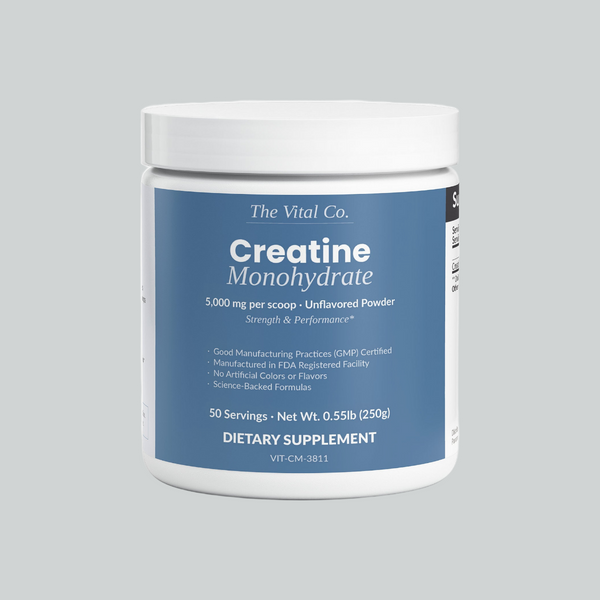
5g per scoop, 50 servings per tub, and nothing else in it. One scoop a day is the maintenance dose in every study above. Four scoops a day for a week is a loading phase, if you decide you want one.
Every amount, on the panel
One ingredient, one number, no proprietary blend. The whole range works the same way.
See the rangeAbout The Vital Co.
Every claim on this site has to trace back to a Supplement Facts panel or to a named published study — author, journal and year, stated where the claim is made rather than collected in a footnote nobody reads. Where a trial used a different amount than we sell, or a different group of people than you, we say so in the same sentence.
Every product at the-vital.co lists every ingredient and every amount on the panel before you buy.
FDA Disclaimer: These statements have not been evaluated by the Food and Drug Administration. These products are not intended to diagnose, treat, cure, or prevent any disease. This article is for educational purposes and is not medical advice. Consult a qualified healthcare professional before starting any supplement, particularly if you are pregnant, nursing, taking prescription medication, or managing a diagnosed condition. Individual results vary.
© 2026 The Vital Co. | the-vital.co