
Why Everything You’ve Tried for Bloating Hasn’t Worked (And What the Research Actually Says)
You cut the dairy, took the probiotics, ate more fiber. So why does your stomach still feel like it inflates every afternoon? Three overlooked mechanisms may explain why — and what to do about them.

You know the feeling. You eat a perfectly reasonable lunch — grilled chicken, some vegetables, maybe a little rice — and by 2 p.m., your stomach has expanded two sizes. Your pants feel tight. You’re uncomfortable, distracted, and frankly exhausted by the whole cycle.
You’ve tried the obvious solutions. You cut out gluten for six weeks. You stopped eating dairy. You bought a $50 probiotic and took it faithfully for three months. You chew slowly. You drink lemon water in the morning. You’ve tried the elimination diet, the low-FODMAP approach, the “clean eating” overhaul.
And still — the bloating comes back.
If any of this sounds familiar, you are not imagining it. In a survey of 88,795 Americans by Oh, Chey and Spiegel (Clinical Gastroenterology and Hepatology, 2023), 13.9% — about one in seven — reported bloating in the previous week, and women reported it at more than twice the rate of men.
The reason most solutions fail is not that they are bad solutions. It is that they treat the symptom while leaving the mechanisms underneath it untouched — and several of those mechanisms shift in a woman’s body from her mid-thirties onward. They point at different interventions than the ones most people try first.
So let’s talk about it.
1 The Enzyme Decline No One Warned You About
Digestive capacity is not fixed for life. Pancreatic enzyme output — the lipase that breaks down fat, and the proteases that break down protein — has been measured declining steadily from the third decade onward.
When food is not fully broken down in the small intestine, it travels on still largely intact, and the bacteria further down ferment it. That fermentation produces hydrogen and methane gas.
That’s your bloating.
The question is not only what you are eating. It is whether your body still has the enzymes to break down what you are eating.
The measurement behind this comes from Laugier and colleagues, who tested pancreatic secretion in 180 people aged 16 to 83 and found lipase, phospholipase and chymotrypsin output falling in a straight line from the third decade on. Women in their forties often report that foods they once tolerated perfectly now cause gas, fullness and distension. That is not necessarily a food sensitivity appearing out of nowhere. It can be a supply-side problem: fewer enzymes meeting the same dietary demands.
One thing worth stating plainly, because the opposite gets repeated a lot: stomach acid does not reliably fall with age. Hurwitz and colleagues found that nearly 90% of people over 65 in their study were still able to acidify the stomach, and that those who were not mostly had serum markers of atrophic gastritis rather than age alone (JAMA, 1997). If your acid is genuinely low, there is usually a specific reason, and that is a conversation for your doctor rather than a supplement.
This is also why simply “eating clean” doesn’t solve the problem. You can eat the most nutrient-dense meal in the world, but if your body doesn’t have the enzymatic machinery to disassemble it, it becomes fuel for bacterial fermentation instead of cellular nutrition.
References: Laugier R, Bernard JP, Berthezene P, Dupuy P. “Changes in pancreatic exocrine secretion with age,” Digestion, 1991;50(3-4):202–11. Hurwitz A et al. “Gastric acidity in older adults,” JAMA, 1997 — which found no age-related decline in acid secretion in healthy older adults.
What the research points to
Enzymes taken with meals have been tested directly. In a randomised, double-blind, placebo-controlled trial by Majeed and colleagues (Journal of Medicinal Food, 2018), forty adults with functional dyspepsia took either a multi-enzyme complex or a placebo with meals for sixty days, and the enzyme group reported significantly less bloating than placebo. That trial enrolled people with a diagnosed digestive condition rather than otherwise healthy adults. It is a small trial, and it was run by the company that makes the enzyme blend it tested — worth knowing when you weigh it.
What matters in a blend is that it covers the macronutrients you actually eat, and that the label tells you how much activity you are getting. Enzymes are measured in activity units rather than milligrams, so a milligram figure on its own tells you very little.

Six enzyme activities, each printed with its units per serving: 2,500 HUT protease, 90 GDU bromelain, 2,670 TU papain, 1,500 FIP lipase, 600 LACU lactase and 300 GALU alpha-galactosidase — covering protein, fat, lactose and the sugars in beans and cruciferous vegetables.
2 Your Hormones Are Quietly Reshaping Your Gut
This one is discussed less often outside academic gastroenterology, and it matters for women whose digestion changes in their late thirties and forties.
Your gut microbiome and your hormonal system are in constant two-way communication. The collection of gut bacteria that metabolises estrogen is called the estrobolome — a term introduced by Plottel and Blaser in Cell Host & Microbe in 2011. Those bacteria produce an enzyme called beta-glucuronidase, which influences how much active estrogen stays in circulation.
Here’s where it gets relevant to bloating: as estrogen and progesterone levels begin fluctuating during perimenopause (which can start as early as 35), the composition of the gut microbiome shifts alongside them.
Baker and colleagues reviewed this two-way relationship in Maturitas in 2017: gut bacteria influence how much estrogen remains active, and estrogen levels in turn influence which bacteria thrive. It is an active area of research, and what is well established is the relationship itself.
Your gut does not only respond to what you eat. It responds to the hormonal shifts your body goes through — and perimenopause is a large one.
Probiotic effects are strain-specific: what a trial showed for one named strain at one dose does not automatically transfer to another strain, which is why the strain list matters more than the headline number. Vital Gut Restore delivers 20 billion CFU across 13 Lactobacillus and Bifidobacterium strains, and every strain is named on the panel so you can look any of them up yourself.
Alongside the bacteria, botanicals address the mechanical side of digestion. Ginger (Zingiber officinale) has been shown to speed gastric emptying: in a crossover study of 24 healthy volunteers by Wu and colleagues, the time for the stomach to half-empty fell from about 27 minutes on placebo to about 13 minutes with ginger. That trial used 1.2g of ginger. Peppermint acts as a smooth-muscle relaxant in the intestinal wall, and the trials generally use enteric-coated peppermint oil. Vital Herbal Digest is a traditional Ayurvedic preparation rather than a single-botanical dose, and every herb and amount is on its panel.
References: Plottel CS, Blaser MJ. “Microbiome and malignancy,” Cell Host & Microbe, 2011;10(4):324–35. Baker JM, Al-Nakkash L, Herbst-Kralovetz MM. “Estrogen–gut microbiome axis,” Maturitas, 2017;103:45–53. Wu KL et al. “Effects of ginger on gastric emptying and motility in healthy humans,” European Journal of Gastroenterology & Hepatology, 2008;20(5):436–40.
What the research points to
A multi-strain probiotic alongside botanicals that support motility covers both halves of this mechanism — the bacteria, and the movement.

20 billion CFU across 13 Lactobacillus and Bifidobacterium strains, every strain named on the panel. Shelf-stable, so it does not need refrigerating.

A 17-herb Ayurvedic blend — turmeric at 150mg and ashwagandha at 125mg are the two largest amounts, alongside Triphala, Trikatu and peppermint leaf. Every herb and every amount is printed on the panel. Contains licorice root — see the product page if you have high blood pressure or take diuretics.
3 The Inflammation Loop That Keeps Bloating Locked In
This is the mechanism that turns occasional bloating into a daily one.
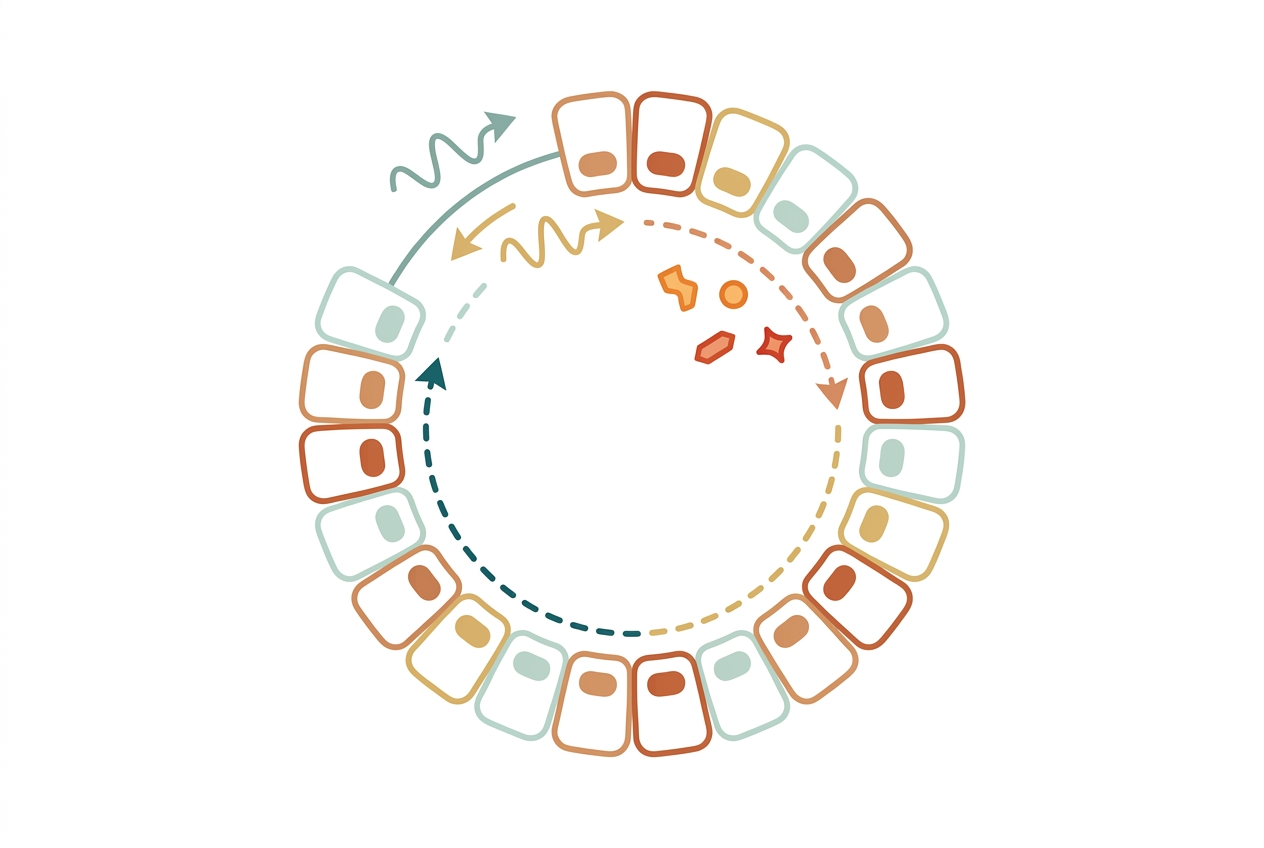
When partially digested food particles interact with a compromised gut lining (see Root Cause #1 and #2 above), they trigger an immune response. The intestinal epithelial cells activate a signaling cascade centered on a protein complex called NF-kB (nuclear factor kappa-light-chain-enhancer of activated B cells). NF-kB is a central switch for inflammatory signalling. When it is activated, it triggers the release of pro-inflammatory cytokines — TNF-a, IL-6, IL-1B — which increase the permeability of the gut lining.
More permeability means more undigested particles crossing the barrier. More crossing means more NF-kB activation. That is the inflammation-permeability loop, and it is well described in the immunology literature. How long it persists, and what reliably interrupts it in otherwise healthy people, is less settled.
Bloating is not only a digestive question. Where inflammation is part of the loop, addressing digestion alone leaves half the picture untouched.
Working on this loop means two things at once: damping the inflammatory signalling, and supplying the nutrients the gut lining is built from.
On the inflammation side, curcumin is the primary active compound in turmeric. Dehzad and colleagues pooled 66 randomised controlled trials and found curcumin supplementation significantly reduced circulating CRP, IL-6 and TNF-a (Cytokine, 2023). In laboratory work curcumin also activates AMPK (AMP-activated protein kinase), a cellular energy sensor involved in inflammatory signalling — mechanism research rather than a clinical outcome.
Curcumin on its own is poorly absorbed, which is why it is usually paired with piperine from black pepper. The 2,000% figure you see quoted comes from Shoba and colleagues in Planta Medica in 1998 — a single-dose human study using 2g of curcumin with 20mg of piperine, in which curcumin taken alone was barely detectable in blood at all. The percentage is real; it is also a ratio measured against a very small starting number.
On the repair side, magnesium is worth having covered. It is a required cofactor for more than 300 enzyme systems in the body — a figure the NIH Office of Dietary Supplements states directly — and NIH ODS also notes that many people in the United States take in less magnesium than recommended.
Omega-3 fatty acids are the other one. EPA and DHA are incorporated into cell membranes throughout the body, including the cells lining the gut. In a randomised trial by Watson and colleagues (Gut, 2018), omega-3 supplementation increased the abundance of several short-chain-fatty-acid-producing bacteria — Bifidobacterium, Roseburia and Lactobacillus among them. Two things that trial also found, and that belong here: overall microbial diversity did not change, and the effect reversed once supplementation stopped.
References: Dehzad MJ et al. “Effects of curcumin/turmeric supplementation on inflammatory biomarkers,” Cytokine, 2023. Shoba G et al. “Influence of piperine on the pharmacokinetics of curcumin in animals and human volunteers,” Planta Medica, 1998;64(4):353–6. Watson H et al. “A randomised trial of the effect of omega-3 polyunsaturated fatty acid supplements on the human intestinal microbiota,” Gut, 2018;67(11):1974–83.
What the research points to
A combined approach: bioavailable curcumin for the inflammatory signalling, magnesium and omega-3s as structural nutrients, and a probiotic to hold the microbial side steady.

800mg turmeric root powder plus 100mg of extract standardised to 95% curcuminoids, with 10mg BioPerine. Contains shellfish — the glucosamine and chondroitin are shellfish-derived.

Magnesium bound to the amino acid glycine. Magnesium is a required cofactor for more than 300 enzyme systems in the body (NIH Office of Dietary Supplements), and many people in the United States take in less than the recommended amount.

180mg EPA and 120mg DHA per softgel, from purified, molecularly distilled fish oil. Both amounts are printed on the panel. Made in the USA from globally sourced ingredients. Contains fish.
Putting It All Together: Why a System Works Better Than a Single Supplement
If you’ve made it this far, one thing should be clear: bloating after 35 is rarely caused by a single issue. It is the convergence of falling enzyme output, hormonal shifts reshaping the microbiome, and an inflammatory loop that compounds over time.
That’s why a single probiotic or a turmeric capsule in isolation often delivers underwhelming results. Addressing all three at once is the more sensible starting point:
- Replace the digestive enzymes your body is producing less of
- Restore with a multi-strain probiotic and motility-supporting botanicals
- Repair the gut lining by damping NF-kB-driven inflammation and supplying the structural nutrients — magnesium and omega-3s — that epithelial cells depend on
Replace, Restore, Repair is how the six formulas in this article fit together. If six is more than you want to start with, three of them — Digestive Enzyme Pro, Gut Restore and Herbal Digest — are also sold as a single product, the De-Bloat & Digest Stack, at $64.90.
Every ingredient and every amount, printed on the panel before you buy.
Add All 6 Products to Cart — $166.45All six formulas for complete gut supportStart with six, or start with three
All six formulas, every amount on the panel. Or the three gut formulas as one product.
Add All 6 to CartOr the De-Bloat & Digest Stack — $64.90
Get the Free 7-Day De-Bloat Reset Protocol
The protocol includes a day-by-day supplement schedule, meal timing guidance, and when to take each formula. No purchase required.
About The Vital Co.
The Vital Co. was founded on a single principle: what we say about a formula should stay inside what the research actually measured. That means every amount printed on the panel, allergens disclosed on the page, and manufacturing in FDA-registered facilities following Good Manufacturing Practices.
We formulate for people who read labels and ask questions. Every product at the-vital.co lists every ingredient and every amount — because that’s the only way to make an informed decision about what goes into your body.
FDA Disclaimer: *These statements have not been evaluated by the Food and Drug Administration. These products are not intended to diagnose, treat, cure, or prevent any disease. The information provided in this article is for educational purposes only and is not intended as medical advice. Always consult with a qualified healthcare professional before starting any new supplement regimen, especially if you are pregnant, nursing, taking medication, or have a medical condition. Individual results may vary.
© 2026 The Vital Co. | the-vital.co