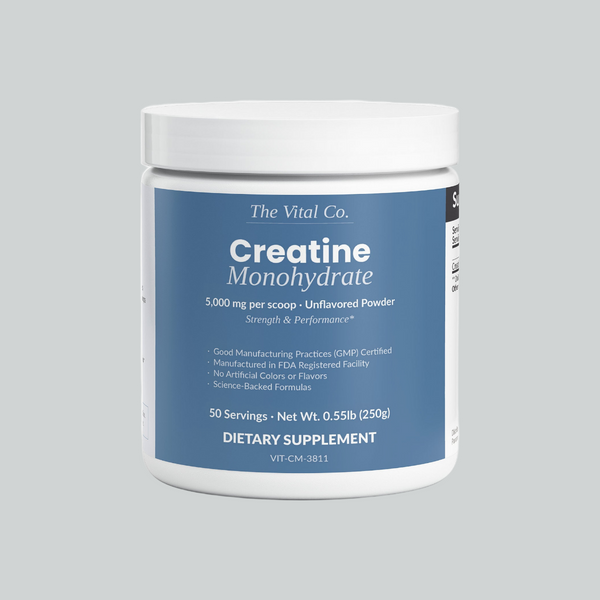
Creatine monohydrate is among the most extensively studied sports supplements in history, yet its benefits extend well beyond the weight room. Recent systematic reviews and randomized controlled trials have expanded the evidence base into cognitive performance, bone health, aging populations, and recovery from muscle disuse — areas that may surprise even longtime users.
So what does the current clinical evidence actually support? This article examines the peer-reviewed research on creatine monohydrate benefits across multiple health domains, with a focus on study quality, dosing protocols, and the populations most likely to benefit.
This article is for informational purposes only and does not constitute medical advice. Consult your physician before starting any supplement.
How Creatine Works in the Body
Creatine is a naturally occurring compound synthesized from the amino acids arginine, glycine, and methionine, primarily in the liver and kidneys. Approximately 95% of the body's creatine is stored in skeletal muscle as phosphocreatine, where it serves as a rapid energy buffer during high-intensity activity. When muscles contract, they consume ATP (adenosine triphosphate). Phosphocreatine donates its phosphate group to regenerate ATP, allowing sustained power output during short bursts of effort.
Supplementation with creatine monohydrate increases intramuscular phosphocreatine stores by approximately 20–40%, depending on baseline levels and dosing protocol. This expanded energy reservoir is the mechanism behind most of creatine's documented benefits — from improved sprint performance to enhanced recovery between exercise bouts. But as recent research shows, creatine's role is not limited to muscle cells: the brain also relies on phosphocreatine for energy metabolism, which has opened new lines of investigation into cognitive applications.
Exercise Performance and Sprint Power
The ergogenic effects of creatine monohydrate on short-duration, high-intensity exercise are among the most well-replicated findings in sports nutrition science. A comprehensive review by Kerksick, Gonzalez, Stout et al. (2026) published in the Journal of the International Society of Sports Nutrition traced the historical trajectory of this evidence, concluding that creatine remains one of the most effective and well-supported ergogenic aids available. The review encompassed decades of research across diverse populations and exercise modalities, reinforcing creatine's role in enhancing power output, work capacity, and training adaptations.
More specific data on acute performance comes from Eken, Uçar, Kurtoğlu et al. (2026), who conducted a randomized, double-blind crossover trial in recreationally active men examining creatine monohydrate's effects on repeated-sprint power, countermovement jump height, and cognitive reaction time (measured via the Stroop test). Published in Metabolites, the study found that acute creatine supplementation improved repeated-sprint performance and maintained power output across successive bouts — a finding with direct relevance for team sport athletes and interval-based training.[1]
What This Means in Practice
The evidence is strongest for activities lasting under 30 seconds that require maximal effort: sprinting, jumping, heavy resistance sets, and explosive movements. Creatine does not meaningfully improve endurance performance in long-duration aerobic exercise, and studies examining its effects on activities longer than several minutes generally show negligible benefit. The mechanism is straightforward: phosphocreatine is depleted rapidly during maximal effort, and supplementation increases the available pool.
Lean Mass, Strength, and Bone Density
Beyond acute performance, creatine monohydrate has a growing evidence base for body composition and skeletal health — particularly in populations where these outcomes carry clinical significance.
Naddafha, Antonio, Kreider et al. (2026) published a systematic review and meta-analysis in the Journal of the International Society of Sports Nutrition examining creatine monohydrate's effects on lean mass, strength, and bone mineral density specifically in postmenopausal women. The pooled data indicated that creatine supplementation combined with resistance training produced greater gains in lean body mass and upper- and lower-body strength compared to resistance training alone. The meta-analysis also found modest positive effects on bone mineral density at certain skeletal sites, a clinically meaningful outcome given the accelerated bone loss that follows menopause.[5]
These findings are particularly notable because postmenopausal women face compounding risks: declining estrogen reduces both muscle protein synthesis and bone mineral accrual. A safe, inexpensive supplement that augments the effects of resistance training on both lean mass and bone density addresses two major clinical concerns simultaneously.
Cognitive Function and Neuroprotection
The brain accounts for roughly 20% of the body's resting energy expenditure, and phosphocreatine plays a role in cerebral energy metabolism. This has led researchers to investigate whether creatine supplementation can protect or enhance cognitive function, particularly under conditions of metabolic stress.
Gordji-Nejad, Matusch, Hengstler et al. (2026) published a study in Nutrients examining whether a single dose of creatine could attenuate cognitive decline caused by sleep deprivation. The results demonstrated that creatine reduced sleep deprivation-induced deterioration in cognitive performance, suggesting that supplementation may buffer the brain's energy supply when metabolic demand outstrips normal capacity.[7] While this was an acute dosing study, the findings align with the broader hypothesis that creatine supports brain bioenergetics under stress.
On the preclinical side, Sal-Sarria and Fernández-Blanco (2026) published a systematic review of creatine and cognitive function in rodent models in Behavioural Brain Research. The review synthesized behavioral and neurobiological evidence, finding consistent support for creatine's neuroprotective properties across multiple animal models of cognitive challenge, including injury and neurodegeneration paradigms.[3] While animal data cannot be directly translated to human clinical outcomes, the consistency of the findings across models strengthens the mechanistic rationale for human trials.
Important Caveats
Cognitive research on creatine in humans is still emerging. Most human studies have examined specific stress conditions (sleep deprivation, acute mental fatigue) rather than long-term cognitive enhancement in healthy, well-rested individuals. The animal evidence is supportive but human clinical trials with larger samples and longer durations are still needed to establish definitive cognitive benefits.
Recovery from Muscle Disuse and Inactivity
One of the more clinically relevant — and underappreciated — applications of creatine is in recovery from periods of muscle disuse, such as post-surgery immobilization, bed rest, or injury-related inactivity.
Stout and Pabian (2026) published a review in Sports Medicine and Health Science specifically examining creatine monohydrate supplementation for recovery from muscle disuse, with a particular emphasis on timing of supplementation. The authors concluded that creatine may help attenuate the loss of muscle mass and strength during immobilization, and that the timing of supplementation relative to the disuse period appears to influence outcomes. Initiating creatine before or during the immobilization period — rather than only during rehabilitation — may preserve more muscle tissue and accelerate functional recovery.[2]
This has practical implications for anyone facing planned surgery (such as joint replacement), athletes recovering from injury, or older adults who experience periods of bed rest due to illness or hospitalization.
Musculoskeletal Health in Women
Research has increasingly examined creatine's effects in female populations, where it has historically been understudied.
Chen, Yeh, Lin et al. (2026) published a systematic review and meta-analysis in the International Journal of Medical Sciences evaluating nutritional supplementation combined with exercise for musculoskeletal health in women across reproductive stages. The review assessed proteins, amino acids, and creatine, finding that creatine supplementation — when paired with structured resistance exercise — contributed to improvements in musculoskeletal outcomes. The analysis spanned women from premenopausal through postmenopausal stages, suggesting that creatine's benefits are not limited to a single hormonal context.[4]
This is important because women have historically been underrepresented in creatine research, and some women have avoided the supplement due to misconceptions about water retention and weight gain. The evidence suggests that creatine-driven mass gains in women are primarily lean tissue when combined with resistance training.
Creatine for Older Adults
Age-related muscle loss (sarcopenia) is a major public health concern, contributing to falls, fractures, loss of independence, and increased mortality. Creatine has emerged as a candidate intervention to augment the effects of exercise in aging populations.
Fernández-González de la Riva, Zambom-Ferraresi et al. (2026) published a study protocol in The British Journal of Nutrition for a randomized controlled trial examining the impact of creatine monohydrate supplementation combined with multicomponent training in adults aged 75 years and older.[6] While results from this trial are still forthcoming, the study design — combining creatine with a structured exercise program in a very elderly population — reflects the growing clinical interest in creatine as a tool for healthy aging.
The rationale is sound: older adults have reduced intramuscular creatine stores, diminished capacity for high-intensity effort, and accelerated muscle protein breakdown. Supplementation addresses the bioenergetic limitation, while exercise provides the mechanical stimulus for muscle adaptation. The combination may be more effective than either intervention alone — a hypothesis that prior research in younger elderly populations has supported.
Dosing: What the Studies Used
Creatine dosing protocols in clinical research generally follow one of two approaches:
Loading Protocol
Approximately 20g per day (divided into 4 doses of 5g) for 5–7 days, followed by a maintenance dose of 3–5g per day. This protocol saturates muscle creatine stores rapidly and is commonly used in short-duration studies where researchers need to achieve maximal intramuscular concentrations quickly.
Maintenance-Only Protocol
3–5g per day without a loading phase. This approach achieves the same muscle saturation levels as the loading protocol, but requires approximately 3–4 weeks to reach full saturation. It avoids the gastrointestinal discomfort that some individuals experience with high loading doses.
The acute crossover trial by Eken et al. (2026) examined single-dose creatine effects, which represents a different paradigm — exploring whether acute supplementation can provide immediate benefits even before full muscle saturation is achieved.[1] However, the weight of evidence supports chronic supplementation (daily dosing over weeks) for most applications.
For cognitive effects, Gordji-Nejad et al. (2026) demonstrated that even a single dose could attenuate cognitive decline under sleep deprivation, suggesting that brain uptake kinetics may differ from skeletal muscle.[7] Some researchers have proposed that higher doses (up to 10–20g/day) may be needed to meaningfully increase brain creatine levels, though this remains under investigation.
The meta-analysis by Naddafha et al. (2026) in postmenopausal women included studies using the standard 3–5g/day maintenance dosing protocol.[5]
Safety and Side Effects
Creatine monohydrate has one of the most robust safety profiles of any dietary supplement. The comprehensive review by Kerksick et al. (2026) affirmed that long-term creatine supplementation at recommended doses (3–5g/day) has not been associated with adverse health effects in healthy populations across hundreds of studies.
Common but Mild Effects
- Water retention: Creatine increases intracellular water content in muscle tissue. This typically adds 1–3 pounds of body weight in the first week. This is not fat gain and is generally not clinically significant.
- Gastrointestinal discomfort: Loading doses (20g/day) can cause bloating, cramping, or nausea in some individuals. Dividing the dose into 4–5 servings or using the maintenance-only protocol typically resolves this.
Kidney Function
The persistent myth that creatine damages kidneys has been repeatedly investigated and not supported by clinical evidence. Creatine does increase serum creatinine levels (a kidney function biomarker), but this is a direct metabolic consequence of higher creatine turnover — not an indication of kidney damage. However, individuals with pre-existing kidney disease should consult their physician before supplementing, as this population has not been adequately studied.
Drug Interactions
Creatine has no well-established dangerous drug interactions. However, because it is processed by the kidneys, caution is warranted when combined with other nephrotoxic agents. Individuals taking NSAIDs at high chronic doses, certain antibiotics, or other medications that affect kidney function should discuss supplementation with their healthcare provider.
Populations Requiring Caution
- Individuals with pre-existing kidney disease or impaired renal function
- Adolescents under 18 (limited long-term safety data in this age group)
- Pregnant or breastfeeding women (insufficient safety data)
What to Look For in a Supplement
The clinical evidence above points to several objective criteria for selecting a creatine supplement:
Form: Creatine Monohydrate
All of the studies reviewed in this article used creatine monohydrate specifically — not creatine hydrochloride, buffered creatine, creatine ethyl ester, or other proprietary forms. The comprehensive review by Kerksick et al. (2026) confirmed that creatine monohydrate remains the most extensively studied and validated form. Alternative forms have not demonstrated superiority in peer-reviewed research, and some have shown inferior bioavailability.
Dose Per Serving
Based on the dosing protocols used across the reviewed studies, look for a product providing 3–5g of creatine monohydrate per serving. This aligns with the maintenance doses used in the meta-analyses examining lean mass, strength, and bone density outcomes.[5] Products providing less than 3g per serving may require multiple servings to reach clinically studied doses.
Purity and Testing
Look for products that carry third-party testing certifications (such as NSF Certified for Sport, Informed Sport, or USP verification). These certifications verify that the product contains what the label claims and is free from banned substances or contaminants. GMP (Good Manufacturing Practice) certification indicates the facility follows standardized production processes.
What to Avoid
- Proprietary blends that do not disclose the exact amount of creatine monohydrate per serving
- Products with excessive additives — creatine monohydrate is effective as a standalone ingredient and does not require added sugars, artificial colors, or stimulants
- Underdosed formulations in multi-ingredient pre-workouts where creatine is included at 1–2g per serving (below the clinically studied dose range)
The Bottom Line
The evidence supporting creatine monohydrate benefits is strong and continues to expand. Decades of research, affirmed by recent systematic reviews and meta-analyses, establish creatine as one of the most effective supplements for improving exercise performance, lean mass, and strength — with emerging evidence for cognitive protection, bone density, and recovery from disuse. The populations with the strongest evidence base include athletes engaged in high-intensity training, postmenopausal women seeking to preserve muscle and bone, and adults recovering from periods of inactivity. As ongoing trials in older adults and cognitive health report results, the scope of clinically validated applications is likely to broaden further.

Frequently Asked Questions
Is creatine monohydrate only useful for bodybuilders?
No. While creatine was initially popular in strength sports, the current evidence extends to postmenopausal bone health, cognitive function under stress, recovery from immobilization, and musculoskeletal health in women across different life stages. The meta-analysis by Naddafha et al. (2026) specifically examined non-athletic postmenopausal women and found benefits for lean mass, strength, and bone density.[5]
Do I need a loading phase?
Not necessarily. A loading phase (20g/day for 5–7 days) saturates muscle creatine stores faster, but a maintenance dose of 3–5g/day achieves the same saturation within approximately 3–4 weeks. The maintenance-only approach is better tolerated and equally effective for long-term use.
Can creatine help with brain function?
Emerging evidence is promising but still developing. Gordji-Nejad et al. (2026) demonstrated that a single creatine dose reduced cognitive decline during sleep deprivation in humans,[7] and a systematic review of animal studies found consistent neuroprotective effects.[3] However, large-scale human trials on long-term cognitive enhancement in healthy, well-rested individuals are still needed.
Does creatine cause kidney damage?
In healthy individuals with normal kidney function, creatine supplementation at recommended doses (3–5g/day) has not been associated with kidney damage across hundreds of studies spanning decades of research. Creatine does elevate serum creatinine (a kidney biomarker), but this reflects normal creatine metabolism, not organ damage. Individuals with pre-existing kidney conditions should consult a physician.
Should women take creatine?
The evidence supports creatine use in women. Chen et al. (2026) found that creatine combined with resistance exercise improved musculoskeletal health in women across reproductive stages,[4] and Naddafha et al. (2026) demonstrated benefits specifically in postmenopausal women.[5] Concerns about excessive weight gain from creatine in women are largely unfounded — observed mass increases are primarily lean tissue and intracellular water.
- Eken Ö, Uçar H, Kurtoğlu A et al. "Acute Responses to Creatine Monohydrate and L-Arginine, Alone and Combined, on Repeated-Sprint Power, Countermovement Jump Height, and Stroop Reaction Time in Recreationally Active Men: A Randomized Double-Blind Crossover Trial." Metabolites, 2026. DOI: [[DOI unavailable] unavailable]
- Stout JR, Pabian PS. "Creatine monohydrate supplementation for recovery from muscle disuse: Timing matters." Sports Medicine and Health Science, 2026. DOI: https://doi.org/10.1016/j.smhs.2026.05.006
- Sal-Sarria S, Fernández-Blanco A. "Creatine and cognitive function in rodents: A systematic review of behavioral and neurobiological evidence." Behavioural Brain Research, 2026. DOI: https://doi.org/10.1016/j.bbr.2026.116340
- Chen KH, Yeh TP, Lin SC et al. "Nutritional Supplementation Combined with Exercise for Musculoskeletal Health in Women: A Systematic Review and Meta-Analysis Evaluating Proteins, Amino Acids, and Creatine across Reproductive Stages." International Journal of Medical Sciences, 2026. DOI: https://doi.org/10.7150/ijms.130435
- Naddafha S, Antonio J, Kreider RB et al. "Creatine monohydrate for lean mass, strength, and bone density in postmenopausal women: a systematic review and meta-analysis." Journal of the International Society of Sports Nutrition, 2026. DOI: [[DOI unavailable] unavailable]
- Fernández-González de la Riva M, Zambom-Ferraresi F et al. "Impact of creatine monohydrate supplementation combined with multicomponent training in older adults (≥ 75 years): study protocol of a randomised controlled trial." The British Journal of Nutrition, 2026. DOI: https://doi.org/10.1017/S0007114526107302
- Gordji-Nejad A, Matusch A, Hengstler L et al. "Single-Dose Creatine Reduces Sleep Deprivation-Induced Deterioration in Cognitive Performance." Nutrients, 2026. DOI: [[DOI unavailable] unavailable]