Beans, Broccoli, and the Sugars No Human Can Digest
No human gut secretes the enzyme that breaks down the sugars in beans and cruciferous vegetables. Two randomised trials tested supplying it. Here is what they found, and how to read an enzyme label.
There is a category of food that reliably causes gas in people whose digestion is otherwise fine: beans, lentils, chickpeas, broccoli, cabbage, brussels sprouts, cauliflower. The reason is specific, it is well understood, and there is an enzyme that addresses it directly.

The sugars humans cannot break down
Those foods contain a family of carbohydrates called galacto-oligosaccharides — sugars built from galactose units linked together. Human beings do not secrete an enzyme into the gut capable of breaking those particular links. Not some people. Nobody.
So they pass through the small intestine intact and arrive in the colon, where your gut bacteria are perfectly equipped to ferment them. Fermentation produces gas. Gas produces pressure, distension and the specific afternoon discomfort that follows a lunch containing chickpeas.
The enzyme that breaks those links is alpha-galactosidase. Taken with the meal, it does the job in the small intestine that your own enzymes cannot, so less of the sugar reaches the bacteria.
This is not a sensitivity you developed. No human secretes this enzyme into the gut. The difference between people is how much fermentation they notice.
What the trials found
Di Stefano and colleagues at the University of Pavia ran a randomised, double-blind, placebo-controlled crossover trial of alpha-galactosidase, testing two amounts — 300 and 1,200 GalU — against placebo, and measuring breath hydrogen over eight hours as an objective marker of fermentation (Digestive Diseases and Sciences, 2007). Both doses significantly reduced the total symptom score compared with placebo, and the higher dose significantly reduced flatulence severity. It was a small study — eight healthy volunteers — and worth reading as such.
Ganiats and colleagues at the University of California, San Diego ran a larger double-blind crossover trial in 19 participants, using roughly 260 GalU with a meal (Journal of Family Practice, 1994). Flatulence over the six hours after eating was significantly lower on the enzyme than on placebo (P = 0.016), with the clearest separation around the fifth hour (P = 0.04) — which is about when a bean-heavy meal reaches the colon. Bloating and abdominal pain, which they rated separately, did not differ from placebo. Gas did, and gas was the thing the enzyme was supposed to act on.
Two independent trials, thirteen years apart, came at the same mechanism from different directions: Di Stefano measured the hydrogen on the breath, Ganiats counted what happened over the following six hours. Both found the enzyme acted on it. The amounts that produced those results — 260 GalU in one, 300 and 1,200 in the other — are the relevant thing to compare a label against.
Why enzymes are measured in strange units
You will notice those trials are described in GalU, not milligrams, and that is the single most useful thing to understand about reading an enzyme label.
Enzymes are catalysts. What matters is not how much of the protein is present by weight but how much work it can do, so they are measured in activity units — GalU for alpha-galactosidase, HUT for protease, FIP for lipase, LACU for lactase, GDU for bromelain, TU for papain. Each unit is defined by a standardised assay measuring how much substrate the enzyme converts under fixed conditions.
The practical consequence: a label that gives you a milligram figure for an enzyme blend has told you almost nothing. Two products with identical milligram figures can differ several-fold in actual activity. If a panel does not print activity units, there is no way to compare it against any trial that has ever been run.
Your own enzyme output, and what happens to it
Separately from the sugars nobody can digest, there is the question of the enzymes you make yourself. Laugier and colleagues measured pancreatic secretion in 180 people aged 16 to 83, stimulating the pancreas directly with secretin and cholecystokinin and collecting what it produced (Digestion, 1991). Output of lipase, phospholipase and chymotrypsin fell linearly from the third decade onward.
That is a gradual, normal change rather than a disorder. What Laugier measured was secretion rather than symptoms — the supply side of the equation. But the demand a meal makes does not fall to match it.
What is on our panel
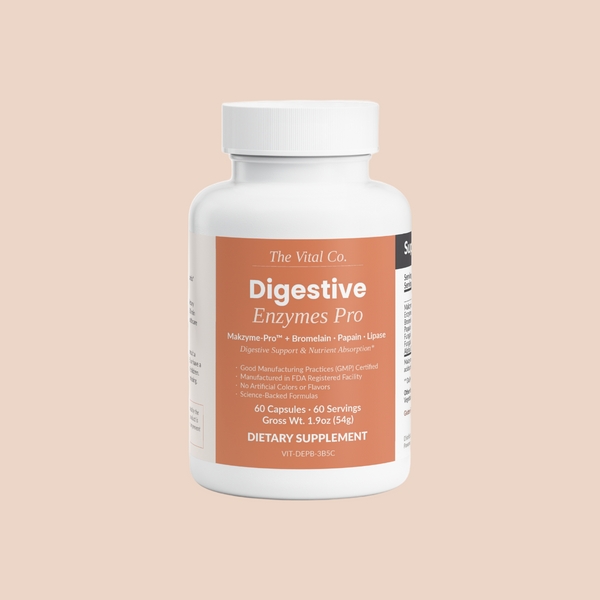
Vital Digestive Enzyme Pro prints six enzyme activities, each with its units per serving:
- 300 GALU alpha-galactosidase — the sugars in beans and cruciferous vegetables. This matches the lower dose Di Stefano tested and is above the amount Ganiats used.
- 2,500 HUT of protease activity from the Makzyme-Pro™ blend, with 90 GDU bromelain and 2,670 TU papain — three routes at protein.
- 1,500 FIP lipase — fat.
- 600 LACU lactase — the sugar in dairy.
Enzymes act on the meal they arrive with, so timing is not flexible. Take one capsule at the start of eating, not afterwards.
Six enzyme activities, each printed with its units per serving: 2,500 HUT protease, 90 GDU bromelain, 2,670 TU papain, 1,500 FIP lipase, 600 LACU lactase and 300 GALU alpha-galactosidase. Contains magnesium stearate and silicon dioxide.
De-Bloat & Digest Stack
Digestive Enzyme Pro with Gut Restore — two full-size bottles, $41.52 for both, against $48.85 bought separately.
See the stackAbout The Vital Co.
Every claim on this site has to trace back to a Supplement Facts panel or to a named published study — author, journal and year, stated where the claim is made rather than collected in a footnote nobody reads. Where a trial used a different amount than we sell, or a different group of people than you, we say so in the same sentence.
Every product at the-vital.co lists every ingredient and every amount on the panel before you buy.
FDA Disclaimer: These statements have not been evaluated by the Food and Drug Administration. These products are not intended to diagnose, treat, cure, or prevent any disease. This article is for educational purposes and is not medical advice. Consult a qualified healthcare professional before starting any supplement, particularly if you are pregnant, nursing, taking prescription medication, or managing a diagnosed condition. Individual results vary.
© 2026 The Vital Co. | the-vital.co