CoQ10: Why Levels Fall With Age, and Why You Should Take It With Food
Tissue concentrations peak around twenty and fall from there. And the single largest factor in whether you absorb a capsule at all is what you eat alongside it.
Most claims that a nutrient “declines with age” are vague. For coenzyme Q10 the claim is unusually specific, because somebody went and measured it in human tissue.
Kalén, 1989 — seven organs, donors from one day old to eighty-one
Kalén, Appelkvist and Dallner analysed ubiquinone — the chemical name for CoQ10 — in seven human organs: lung, heart, spleen, liver, kidney, pancreas and adrenal gland, from donors ranging from one day old to 81 years (Lipids, 1989). In five of those organs, including the heart, concentrations peaked at around age twenty and decreased continuously from there. In the pancreas and adrenal, the peak came much earlier, at about one year.
That is a thirty-five-year-old paper, and it remains the clearest tissue-level measurement of the decline. It is also the reason CoQ10 is framed as an after-forty supplement rather than a general one.
What CoQ10 actually does
Inside every cell are mitochondria, and inside mitochondria is a sequence of proteins called the electron transport chain. Energy from the food you eat is handed along that chain step by step, and at the end of it the cell captures what is left as ATP — the molecule your body actually spends when it does anything.
CoQ10 is one of the carriers in that chain. It physically shuttles electrons from one complex to the next. It is not a signalling compound or a modulator; it is a component. The organs that use the most energy — heart, liver, kidney — are the ones that carry the most of it, which is a fairly direct clue about what it is for.
CoQ10 is not doing something to your mitochondria. It is a part of them.
The one thing that determines whether you absorb it
Take it with fat. This is not optional advice and it is not a marketing line — it is the single largest variable in whether the capsule you paid for reaches your bloodstream.
Bhagavan and Chopra reviewed the pharmacokinetics of CoQ10 and were direct about the reason (Free Radical Research, 2006). CoQ10 is lipophilic, so it follows the same absorption route through the gut as the fat in your food. Absorption is poor to begin with, because the molecule is insoluble in water, only modestly soluble in lipids, and physically large. Their conclusion on the practical point is unambiguous: absorption is enhanced in the presence of lipids, and absorption of a supplement improves when it is taken with a fatty meal. They also note the time to peak blood concentration is around six hours, so this is a slow process rather than a quick one.
Taken on an empty stomach, a CoQ10 capsule is largely wasted. Taken with breakfast that includes eggs, or with the same meal as your omega-3, it is not.
Ubiquinone, which is what we use
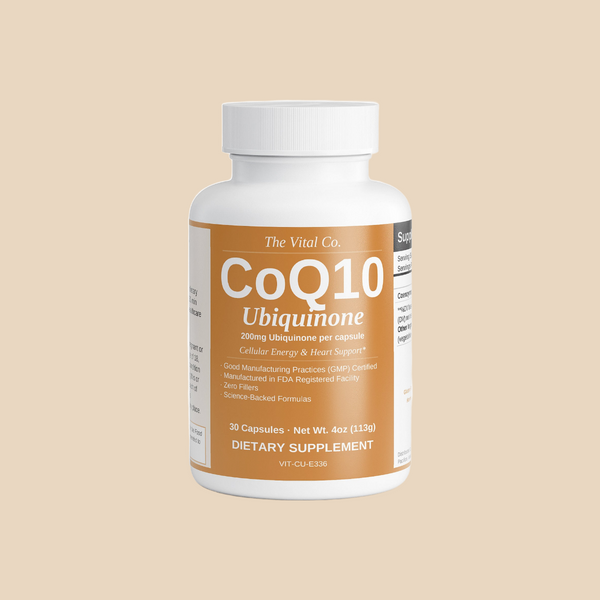
CoQ10 is sold in two forms, ubiquinone and ubiquinol, and there is a long-running argument about which is better absorbed. We use ubiquinone, at 200mg per capsule. It is the form used in the large body of older clinical work, it is more stable on a shelf, and the absorption question is genuinely unsettled enough that we are not going to make a claim about it in either direction.
200mg of CoQ10 as ubiquinone per capsule. Take it with a meal containing fat.
CoQ10 is also one of the three formulas in the Longevity & Cellular Stack, where it sits alongside 500mg of NAD+ and 500mg of NMN — the coenzyme, the precursor your body builds it from, and the carrier that puts the result to work.
Longevity & Cellular Stack
NAD+, NMN and CoQ10 — $85.00 for three full-size bottles, against $121.70 bought separately.
See the stackAbout The Vital Co.
Every claim on this site has to trace back to a Supplement Facts panel or to a named published study — author, journal and year, stated where the claim is made rather than collected in a footnote nobody reads. Where a trial used a different amount than we sell, or a different group of people than you, we say so in the same sentence.
Every product at the-vital.co lists every ingredient and every amount on the panel before you buy.
FDA Disclaimer: These statements have not been evaluated by the Food and Drug Administration. These products are not intended to diagnose, treat, cure, or prevent any disease. This article is for educational purposes and is not medical advice. Consult a qualified healthcare professional before starting any supplement, particularly if you are pregnant, nursing, taking prescription medication, or managing a diagnosed condition. Individual results vary.
© 2026 The Vital Co. | the-vital.co