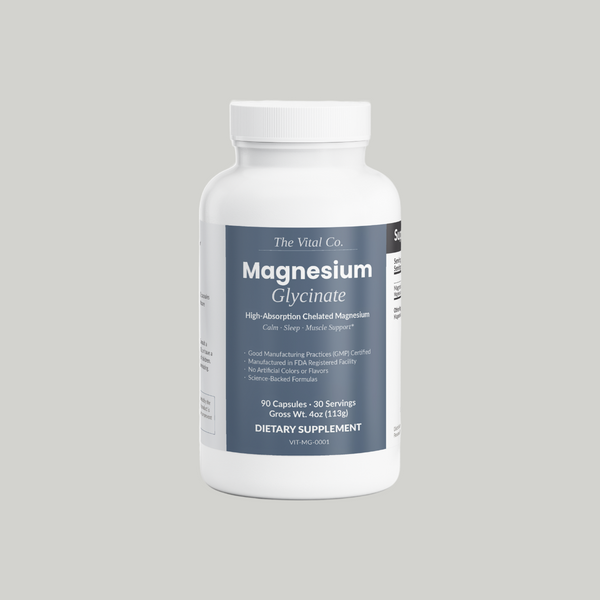
Magnesium supplements line every pharmacy shelf, but the form you choose may determine whether that magnesium actually reaches your cells. Magnesium glycinate and magnesium oxide are two of the most widely available options — yet they differ sharply in absorption, tolerability, and clinical application. Understanding those differences requires looking beyond marketing claims and into the published research.
This article is for informational purposes only and does not constitute medical advice. Consult your physician before starting any supplement.
Why the Form of Magnesium Matters
Magnesium is the fourth most abundant mineral in the human body and serves as a cofactor in more than 300 enzymatic reactions, including energy production, protein synthesis, muscle and nerve function, and blood glucose regulation. Despite its importance, dietary surveys consistently estimate that a significant portion of adults in Western countries consume less magnesium than the recommended dietary allowance (RDA).
When dietary intake falls short, supplementation becomes a practical option — but not all magnesium supplements are created equal. The mineral itself must be bound to another molecule (a "carrier") to form a stable compound suitable for oral consumption. That carrier molecule profoundly influences how much elemental magnesium the body can absorb, how well it is tolerated in the gut, and which clinical scenarios each form is best suited for.
The two most commonly compared forms — magnesium glycinate and magnesium oxide — sit at opposite ends of the bioavailability spectrum. Understanding why requires a brief look at their chemistry.
The Chemistry: Glycinate vs. Oxide
Magnesium Glycinate (Magnesium Bisglycinate)
Magnesium glycinate is an organic chelate in which elemental magnesium is bound to two molecules of glycine, the smallest amino acid. This chelated structure is significant: the amino acid bonds may shield the magnesium ion as it passes through the gastrointestinal tract, potentially facilitating absorption through amino acid transport pathways rather than relying solely on passive mineral diffusion. The elemental magnesium content per gram of compound is relatively low — roughly 14% by weight — which means capsules or tablets must be larger or taken in greater numbers to deliver a meaningful dose.
Magnesium Oxide
Magnesium oxide is an inorganic salt with the highest elemental magnesium concentration of any common supplement form — approximately 60% by weight. This density is its primary commercial advantage: a single 500 mg tablet of magnesium oxide provides about 300 mg of elemental magnesium. However, the tight ionic bond between magnesium and oxygen is not easily dissociated in the gut, which raises questions about how much of that magnesium is actually available for absorption.
Absorption and Bioavailability: Head-to-Head Evidence
The central question in the magnesium glycinate vs. oxide debate is bioavailability — the fraction of ingested magnesium that reaches systemic circulation and is available for physiological use. While numerous studies have examined individual magnesium forms, direct head-to-head comparisons in controlled human trials remain relatively limited.
The Schuette et al. Absorption Study
One of the most frequently cited direct comparisons comes from Schuette, Lashner, and Janghorbani (1994), who conducted a study at a clinical research center comparing the bioavailability of magnesium diglycinate (glycinate) versus magnesium oxide in patients with ileal resection — a population particularly vulnerable to mineral malabsorption. Using stable isotope tracers (25Mg and 26Mg), the researchers measured true fractional magnesium absorption from each form. The study found that magnesium diglycinate demonstrated significantly higher bioavailability than magnesium oxide in this patient population, supporting the hypothesis that the amino acid chelate structure facilitates absorption even when intestinal absorptive surface area is compromised.
This study is important for several reasons. First, the use of stable isotope tracers is considered a gold-standard method for measuring mineral absorption, providing more precise data than simple serum level monitoring. Second, the patient population — individuals with ileal resection — represents a clinically meaningful group where magnesium supplementation is often medically necessary, not merely optional.
It should be noted, however, that this study was conducted in a specific clinical population with compromised intestinal function. Absorption differences between forms may be less pronounced in healthy individuals with intact gastrointestinal tracts, though data in healthy populations is more limited for this specific head-to-head comparison.
Clinical Evidence in Severe Deficiency
A more recent case report by Tran and Miller (2026) described a patient with persistent hypomagnesemia resulting from both malabsorption and renal magnesium wasting. The patient had failed to achieve adequate magnesium repletion with standard oral formulations and was treated with high-dose magnesium glycinate. The authors reported successful correction of magnesium levels with the glycinate form, suggesting that its absorption characteristics may offer clinical advantages in difficult-to-treat deficiency states.[2]
While a single case report represents a low level of evidence and cannot establish causation or generalizability, it adds to the clinical narrative supporting magnesium glycinate's absorption profile, particularly in patients where other forms have proven insufficient.
What General Research Suggests
Beyond these specific studies, the broader magnesium literature provides context. Some evidence suggests that organic magnesium salts (those bound to amino acids or organic acids, such as glycinate, citrate, and taurate) tend to demonstrate higher fractional absorption than inorganic salts (oxide, sulfate, carbonate). The proposed mechanisms include better solubility in intestinal fluid, reduced competition with dietary inhibitors like phytate, and potential utilization of amino acid absorption pathways.
Preliminary research indicates that magnesium oxide absorption in healthy adults may range from approximately 4% to 10% of the ingested dose, though estimates vary across studies depending on methodology, dose, and whether the supplement was taken with food. Some researchers have reported somewhat higher absorption rates for organic forms, though the magnitude of the difference in healthy populations remains a subject of ongoing investigation.
It is important to note that lower fractional absorption does not necessarily mean magnesium oxide is ineffective. Because magnesium oxide delivers substantially more elemental magnesium per tablet (roughly 300 mg per 500 mg tablet vs. approximately 70 mg per 500 mg tablet of glycinate), the absolute amount of magnesium absorbed may partially compensate for the lower absorption rate — though at the cost of more unabsorbed magnesium remaining in the gut, which carries its own implications for tolerability.
Clinical Applications and Use Cases
When Magnesium Glycinate May Be Preferred
Based on the available evidence, magnesium glycinate appears to offer advantages in several clinical scenarios:
Malabsorption conditions: The Schuette et al. study specifically demonstrated superior absorption in patients with ileal resection, suggesting that the chelated form may be particularly valuable for individuals with Crohn's disease, short bowel syndrome, celiac disease, or other conditions that reduce intestinal absorptive capacity.
Refractory hypomagnesemia: The Tran and Miller case report supports considering magnesium glycinate when standard formulations fail to correct deficiency, particularly in complex cases involving both malabsorption and renal wasting.[2]
GI-sensitive individuals: Because more of the magnesium glycinate dose is absorbed in the upper GI tract, less unabsorbed magnesium reaches the colon, where it would draw water into the lumen through osmotic effects. This generally translates to fewer gastrointestinal side effects, particularly diarrhea and cramping.
Sleep and relaxation support: Some evidence suggests that both the magnesium component and the glycine carrier may independently support relaxation and sleep quality. Glycine has been studied as a sleep-supportive amino acid in its own right, though the doses of glycine delivered through standard magnesium glycinate supplementation are modest compared to those used in standalone glycine research.
When Magnesium Oxide May Be Appropriate
Constipation relief: The osmotic laxative effect that makes magnesium oxide less desirable for some people is precisely the mechanism that makes it useful for occasional constipation. The unabsorbed magnesium draws water into the intestinal lumen, softening stool and promoting bowel motility.
Cost-sensitive supplementation: Magnesium oxide is significantly less expensive per serving than glycinate forms and is widely available in high-dose tablets. For individuals who tolerate it well and are not dealing with malabsorption, it remains a practical option.
Acid reflux: Magnesium oxide has antacid properties and is sometimes used in formulations designed to neutralize stomach acid.
Dosing: What the Studies Used
Dosing for magnesium supplements should be understood in terms of elemental magnesium — the actual amount of the mineral itself, distinct from the total weight of the compound.
The Recommended Dietary Allowance (RDA) for magnesium in adults ranges from 310–420 mg per day of elemental magnesium, depending on age and sex. The Tolerable Upper Intake Level (UL) for supplemental magnesium from pharmacological sources (as distinct from food) is set at 350 mg per day of elemental magnesium by the Institute of Medicine — a threshold above which GI side effects become more common.
In the Schuette et al. (1994) study, the researchers administered magnesium diglycinate and magnesium oxide in doses calibrated to deliver equivalent amounts of elemental magnesium, allowing for a fair bioavailability comparison. The specific stable isotope tracer methodology measured fractional absorption rather than testing a particular supplementation regimen.
In the Tran and Miller (2026) case report, high-dose magnesium glycinate was used to correct refractory hypomagnesemia — a clinical scenario in which doses may exceed standard supplementation levels under medical supervision.[2]
For general supplementation, common commercial doses include:
- Magnesium glycinate: Typically sold in doses providing 100–200 mg elemental magnesium per serving, often requiring 2–4 capsules due to the lower elemental magnesium content of the chelate.
- Magnesium oxide: Typically sold in doses providing 250–400 mg elemental magnesium per tablet, achievable in a single pill due to the compound's high elemental magnesium density.
Individuals should aim to bridge the gap between their dietary magnesium intake and the RDA rather than defaulting to the maximum supplemental dose. A healthcare provider can help determine appropriate dosing based on dietary assessment, serum magnesium levels, and individual risk factors for deficiency.
Safety and Side Effects
Gastrointestinal Effects
The most common side effect of magnesium supplementation is gastrointestinal distress, and this is where the two forms diverge most clearly in practice.
Magnesium oxide is more likely to cause diarrhea, abdominal cramping, and nausea — particularly at higher doses. This is a direct consequence of its lower absorption rate: unabsorbed magnesium in the colon exerts osmotic pressure, pulling water into the intestinal lumen. For some people, even moderate doses of magnesium oxide produce laxative effects strong enough to limit its practical utility as a mineral supplement.
Magnesium glycinate is generally reported to be gentler on the gastrointestinal tract. Its higher absorption rate means less unabsorbed magnesium reaches the colon, reducing the osmotic laxative effect. This improved tolerability is one of the primary reasons healthcare providers often recommend glycinate forms for patients who need sustained magnesium supplementation.
Drug Interactions
All magnesium supplements share certain drug interactions that patients should be aware of:
- Antibiotics: Magnesium can bind to tetracycline and fluoroquinolone antibiotics (such as ciprofloxacin), reducing their absorption. Magnesium supplements should be taken at least 2 hours before or 4–6 hours after these medications.
- Bisphosphonates: Magnesium may interfere with the absorption of osteoporosis medications like alendronate. Separation of at least 2 hours is recommended.
- Diuretics: Loop and thiazide diuretics can increase urinary magnesium excretion, potentially worsening deficiency. Conversely, potassium-sparing diuretics may reduce magnesium excretion.
- Proton pump inhibitors (PPIs): Long-term PPI use has been associated with hypomagnesemia, and patients on these medications may have increased magnesium requirements.
Contraindications
Magnesium supplementation at any dose should be approached with caution — and typically requires medical supervision — in individuals with severe renal impairment, as the kidneys are the primary route of magnesium excretion. Accumulation of magnesium in the setting of impaired kidney function can lead to hypermagnesemia, a potentially dangerous condition with symptoms ranging from hypotension and muscle weakness to cardiac arrhythmia in severe cases.
What to Look For in a Supplement
Based on the research reviewed above, several evidence-based criteria can guide supplement selection:
Form and chelation quality: The absorption advantage demonstrated by Schuette et al. was specifically for magnesium diglycinate — meaning magnesium fully chelated with two glycine molecules. Look for products that list "magnesium bisglycinate" or "magnesium diglycinate" on the label, rather than "magnesium glycinate blend," which may contain a mixture of chelated magnesium and magnesium oxide used as a filler to increase elemental magnesium content per capsule.
Elemental magnesium per serving: Because magnesium glycinate contains only about 14% elemental magnesium by weight, effective doses require multiple capsules. An effective supplement should provide at least 100–200 mg of elemental magnesium per serving. Check the Supplement Facts panel for the elemental magnesium amount, not just the total compound weight.
Third-party testing: Look for supplements that have been independently verified by organizations such as NSF International, USP (United States Pharmacopeia), or ConsumerLab. These certifications confirm that the product contains what the label claims, is free of heavy metal contamination, and was manufactured under Good Manufacturing Practice (GMP) conditions.
Minimal unnecessary additives: Quality magnesium glycinate supplements should require few excipients beyond the active ingredient and a capsule shell. Be cautious of products with extensive filler lists or those that include magnesium oxide as an undisclosed bulking agent within a "glycinate" product.
Dose splitting: Because magnesium absorption is dose-dependent — smaller doses are absorbed proportionally better than large single doses — products that allow flexible dosing (such as individual capsules providing 100 mg elemental magnesium) enable users to split their daily intake across meals, potentially improving overall absorption.
The Bottom Line
The evidence supporting magnesium glycinate's superior bioavailability over magnesium oxide is moderate — anchored by well-designed absorption studies using isotope tracers, but limited in the number of head-to-head human comparisons. For individuals with malabsorption conditions, GI sensitivity, or refractory deficiency, the published data favors magnesium glycinate as the more reliably absorbed and better-tolerated option. Magnesium oxide retains a role for cost-sensitive general supplementation and for individuals who benefit from its mild laxative properties. Larger randomized trials directly comparing long-term clinical outcomes between forms would strengthen the evidence base considerably.

Frequently Asked Questions
Is magnesium glycinate better absorbed than magnesium oxide?
Based on the available evidence, yes. The Schuette et al. (1994) study using stable isotope tracers demonstrated significantly higher fractional absorption for magnesium diglycinate compared to magnesium oxide in patients with ileal resection. However, most direct comparison studies have been conducted in populations with compromised absorption, and the magnitude of the difference in healthy adults is less well established.
Can I take magnesium glycinate and magnesium oxide together?
There is no known contraindication to combining the two forms, but it is generally unnecessary and may increase the total magnesium load beyond what is needed. If you are combining forms, track the total elemental magnesium from all sources to stay within appropriate intake levels and monitor for GI side effects.
Why is magnesium oxide so much cheaper if it is less well absorbed?
Magnesium oxide is inexpensive to manufacture, has been available for decades, and packs more elemental magnesium per gram of compound than any other common form. Its lower per-unit cost reflects simpler production chemistry, not a judgment on quality. For individuals who tolerate it well and maintain adequate serum magnesium levels, it can be a reasonable choice.
What time of day should I take magnesium glycinate?
There is no strong clinical evidence mandating a specific time. Some individuals prefer taking magnesium glycinate in the evening, as both magnesium and glycine have been associated with relaxation. Splitting the dose between meals may improve absorption, since smaller individual doses tend to be absorbed proportionally better than a single large dose.
How long does it take for magnesium supplementation to correct a deficiency?
This depends on the severity of deficiency and the underlying cause. Mild dietary shortfalls may respond to supplementation within a few weeks, while clinically significant hypomagnesemia — particularly in conditions involving ongoing losses — may require months of consistent supplementation under medical supervision. The Tran and Miller (2026) case report highlighted that refractory cases may require high-dose glycinate formulations to achieve adequate repletion.[2]
- Tran BAC, Miller T. "Hypomagnesemia from malabsorption and renal magnesium wasting treated with high-dose magnesium glycinate: A case report." Journal of the American Pharmacists Association: JAPhA, 2026. DOI: https://doi.org/10.1016/j.japh.2026.103496