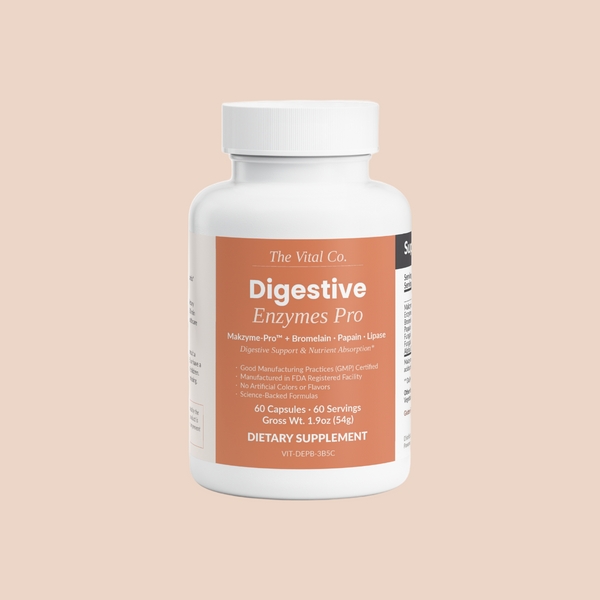
Every time you eat, your body deploys a sophisticated cascade of natural digestive enzymes — proteins that break food into absorbable nutrients. When this system works well, you barely notice it. When it doesn't, the consequences range from mild bloating to serious malabsorption. Understanding how these enzymes function, what disrupts them, and whether supplemental enzymes have clinical merit is essential for anyone dealing with persistent digestive complaints.
This article reviews the biology of natural digestive enzymes, the conditions that impair their production, and the current state of evidence on enzyme supplementation.
This article is for informational purposes only and does not constitute medical advice. Consult your physician before starting any supplement.
Table of Contents
- What Are Natural Digestive Enzymes?
- The Three Major Classes of Digestive Enzymes
- Where Your Body Produces Them
- Conditions That Impair Enzyme Production
- Enzyme-Rich Foods: Do They Actually Help?
- Digestive Enzyme Supplements: What the Research Indicates
- Dosing: What the Studies Used
- Safety and Side Effects
- Frequently Asked Questions
- References
What Are Natural Digestive Enzymes?
Digestive enzymes are biological catalysts — proteins that accelerate the chemical reactions needed to break large food molecules into smaller, absorbable units. Without them, the nutrients locked inside proteins, fats, and carbohydrates would pass through the gastrointestinal tract largely undigested.
Your body produces more than 20 distinct digestive enzymes, each with a highly specific job. Some cleave peptide bonds in proteins, others hydrolyze starch into simple sugars, and still others emulsify and break down dietary fats. This specificity is what makes digestion efficient — and also what makes it vulnerable. If production of even one key enzyme drops below a critical threshold, the downstream effects on nutrient absorption can be significant.
Unlike metabolic enzymes that operate inside cells, digestive enzymes are secretory: they are produced by specialized glands and released into the gastrointestinal lumen, where they do their work extracellularly. This distinction matters because it means digestive enzymes must survive the harsh environment of the gut — acidic pH in the stomach, alkaline conditions in the small intestine — and function optimally within narrow pH windows.
The Three Major Classes of Digestive Enzymes
Proteases: Breaking Down Protein
Proteases (also called proteolytic enzymes or peptidases) cleave the peptide bonds that link amino acids together in protein chains. The stomach produces pepsin, which works in highly acidic conditions (pH 1.5–2.5) and begins the process of protein denaturation and hydrolysis. The pancreas then releases trypsin, chymotrypsin, and carboxypeptidase into the duodenum, continuing the breakdown in a more alkaline environment (pH 7–8). Finally, brush-border peptidases on the intestinal wall complete the process, yielding individual amino acids and dipeptides small enough for absorption.
Insufficient protease activity can result in incomplete protein digestion, leading to bloating, gas, and in chronic cases, amino acid deficiencies that affect everything from immune function to muscle repair.
Lipases: Processing Dietary Fats
Lipase enzymes hydrolyze triglycerides — the primary form of dietary fat — into monoglycerides and free fatty acids. Lingual lipase begins fat digestion in the mouth, gastric lipase continues in the stomach, and pancreatic lipase does the bulk of the work in the small intestine. Pancreatic lipase requires bile salts (produced by the liver and stored in the gallbladder) to function effectively, as bile emulsifies large fat globules into smaller micelles, increasing the surface area available for enzymatic action.
Lipase deficiency is clinically significant because fat malabsorption (steatorrhea) leads not only to greasy, foul-smelling stools but also to deficiencies in fat-soluble vitamins A, D, E, and K. Phospholipases represent another important class within the lipase family, playing roles in both digestion and cell membrane remodeling. A recent methodological review by Malcles, Wu, Snini et al. (2027) provides a comprehensive overview of phospholipase classification and analytical approaches, highlighting the structural diversity and functional breadth of these enzymes across biological systems.[1]
Amylases: Digesting Carbohydrates
Amylase enzymes break down starch and glycogen into maltose and eventually glucose. Salivary amylase (ptyalin) begins carbohydrate digestion in the mouth — which is why bread starts tasting sweet if you chew it long enough. Pancreatic amylase then continues the process in the small intestine. Additional brush-border enzymes — maltase, sucrase, and lactase — break disaccharides into monosaccharides for absorption.
Lactase deficiency is the most common specific enzyme deficiency worldwide, affecting an estimated 65–70% of the global adult population to varying degrees. This is not a disease but rather the normal mammalian pattern: lactase production typically declines after weaning. Populations with a long history of dairy farming have higher rates of lactase persistence — the continued production of lactase into adulthood.
Where Your Body Produces Them
Digestive enzyme production is distributed across multiple organs, each contributing enzymes optimized for different stages of digestion:
Salivary glands: Produce salivary amylase and lingual lipase. Digestion begins in the mouth, which is one reason why thorough chewing matters more than most people realize.
Stomach: Chief cells in the gastric lining produce pepsinogen, which is activated to pepsin by hydrochloric acid (secreted by parietal cells). The stomach also produces gastric lipase.
Pancreas: The exocrine pancreas is the primary engine of digestion, producing pancreatic lipase, pancreatic amylase, trypsinogen, chymotrypsinogen, carboxypeptidase, and elastase. These enzymes are secreted as inactive zymogens (to prevent the pancreas from digesting itself) and activated in the duodenum by enterokinase.
Small intestine: The brush border of the intestinal epithelium produces disaccharidases (lactase, maltase, sucrase), peptidases, and other enzymes that complete the final stages of digestion at the absorptive surface.
Liver and gallbladder: While bile is technically not an enzyme, it is essential for lipase function. Bile salts emulsify fats and create the conditions under which pancreatic lipase can efficiently hydrolyze triglycerides.
Conditions That Impair Enzyme Production
Exocrine Pancreatic Insufficiency (EPI)
EPI is the most clinically significant enzyme deficiency. It occurs when the pancreas fails to produce adequate digestive enzymes — typically defined as less than 10% of normal output. Causes include chronic pancreatitis (the most common cause in adults), cystic fibrosis (the most common cause in children), pancreatic cancer, and pancreatic surgery. Symptoms include steatorrhea, weight loss, bloating, and fat-soluble vitamin deficiencies. EPI is diagnosed via fecal elastase-1 testing (values below 200 μg/g suggest insufficiency; below 100 μg/g indicate severe insufficiency).
Age-Related Decline
Some evidence suggests that digestive enzyme output declines with aging, though the extent varies considerably between individuals. Gastric acid production tends to decrease, which indirectly impairs pepsin activation. Pancreatic enzyme output may also decline modestly, though healthy older adults generally maintain adequate digestive function. Age-related changes become clinically relevant mainly when compounded by other factors such as medication use (particularly proton pump inhibitors), chronic disease, or poor nutritional status.
Surgical Alterations
Gastrectomy, pancreatic resection, bariatric surgery, and other procedures that alter gastrointestinal anatomy can significantly impair enzyme production and delivery. Post-surgical enzyme replacement is often medically necessary and well-established in clinical practice.
Inflammatory Conditions
Celiac disease, Crohn's disease, and other inflammatory conditions of the small intestine can damage brush-border enzymes, leading to secondary enzyme deficiencies — most notably secondary lactase deficiency, which often resolves when the underlying inflammation is treated.
Enzyme-Rich Foods: Do They Actually Help?
Many foods contain naturally occurring enzymes, and the idea that consuming enzyme-rich foods can aid digestion is popular in wellness circles. Common examples include:
Pineapple (bromelain): Contains a mixture of proteolytic enzymes. Bromelain can break down protein in laboratory settings and is used commercially as a meat tenderizer. Some preliminary research suggests anti-inflammatory properties when taken in supplement form, but the enzymes in whole pineapple are present in relatively small quantities and are partially denatured by stomach acid.
Papaya (papain): Another proteolytic enzyme used commercially. Some small studies suggest papain-containing supplements may reduce bloating and constipation, but rigorous large-scale trials are limited.
Fermented foods (various): Fermentation processes can produce enzymes, and fermented foods like kimchi, sauerkraut, miso, and kefir contain both microbial enzymes and beneficial bacteria. The enzymatic contribution of these foods to overall digestion is difficult to quantify, and their benefits may relate more to their probiotic content and pre-digested nutrients than to enzyme supplementation per se.
Ginger (zingibain): Contains a protease that has shown activity in laboratory conditions. Traditional use for digestive support spans centuries, but controlled clinical trials specifically on ginger's enzymatic effects are sparse.
The fundamental challenge with food-sourced enzymes is survival: most plant and animal enzymes are proteins, and proteins are themselves broken down by the body's own digestive enzymes and stomach acid. The degree to which food-derived enzymes remain active in the gastrointestinal tract is uncertain and likely variable. This does not mean enzyme-rich foods lack value — many are nutritious for other reasons — but the claim that they meaningfully supplement your body's own enzyme production remains incompletely substantiated by clinical evidence.
Digestive Enzyme Supplements: What the Research Indicates
Prescription Pancreatic Enzyme Replacement Therapy (PERT)
For diagnosed exocrine pancreatic insufficiency, prescription pancreatic enzyme replacement therapy is the standard of care and has robust clinical evidence supporting its use. PERT products (such as pancrelipase formulations) contain standardized doses of lipase, protease, and amylase derived from porcine pancreatic tissue. These are FDA-regulated drugs, not dietary supplements, and their efficacy in improving fat absorption, reducing steatorrhea, and preventing nutritional deficiencies in EPI is well-established through multiple randomized controlled trials.
PERT is typically dosed based on lipase units per meal, with clinical guidelines generally recommending 40,000–50,000 USP units of lipase per meal for adults, adjusted based on response. Enteric coating protects the enzymes from stomach acid degradation.
Over-the-Counter Enzyme Supplements
The over-the-counter digestive enzyme supplement market is far more heterogeneous and less well-studied. Products vary enormously in enzyme types, sources (plant, animal, fungal), potency, and formulation. Key points from the available evidence:
Lactase supplements: These have the strongest evidence base among OTC enzyme products. For individuals with confirmed lactose malabsorption, taking exogenous lactase before consuming dairy can reduce symptoms of lactose intolerance. Multiple small trials have demonstrated symptom improvement, though individual responses vary and the optimal dose depends on the amount of lactose consumed.
Broad-spectrum enzyme blends: Many commercially available supplements contain mixtures of amylase, protease, lipase, cellulase, and other enzymes, often derived from fungal sources (commonly Aspergillus species). These products are marketed for general digestive support, but rigorous clinical trials in healthy populations are limited. Some small studies suggest modest symptom improvements in individuals with functional dyspepsia or self-reported digestive discomfort, but large, well-designed RCTs are lacking.
Alpha-galactosidase: Products containing this enzyme (such as Beano) can help break down galactooligosaccharides in beans, legumes, and cruciferous vegetables — complex sugars that humans lack the endogenous enzymes to digest. Some clinical trials have shown reduced gas production after legume consumption, making this one of the better-supported OTC enzyme applications.
It is worth noting that fungal-derived enzymes from Aspergillus species have broader applications beyond human digestion. For example, Ahmadifar, Arshadi, Mohammadzadeh et al. (2026) demonstrated that Aspergillus niger-fermented watermelon rind enhanced growth performance and immune parameters in Asian seabass, illustrating how fungal enzymatic processing can improve nutrient bioavailability in biological systems.[2] While this animal aquaculture study does not directly apply to human supplementation, it underscores the biological potency of fungal-derived enzymes in enhancing nutrient processing.
Dosing: What the Studies Used
Dosing for digestive enzyme supplements depends heavily on the specific enzyme and the condition being addressed:
Pancreatic enzyme replacement (PERT): Clinical guidelines recommend starting at approximately 500 lipase units per kilogram of body weight per meal, which translates to roughly 25,000–50,000 USP units of lipase per meal for most adults. Half-doses are used for snacks. Doses are adjusted based on clinical response, stool consistency, and nutritional markers. This applies only to diagnosed EPI under physician supervision.
Lactase: Studies have used doses ranging from 3,000 to 9,000 FCC (Food Chemical Codex) units per serving of dairy. Higher lactose loads require higher doses. Timing matters — lactase should be taken immediately before or with the first bite of dairy-containing food, as the enzyme must be present in the gut simultaneously with the lactose.
Alpha-galactosidase: Studies have generally used 300–1,200 GalU (galactose units) taken immediately before a meal containing gas-producing foods. Most commercial products provide 300–450 GalU per tablet.
Bromelain: When studied for anti-inflammatory or digestive purposes, doses have ranged from 500 to 2,000 GDU (gelatin-digesting units) per day, typically divided across meals. However, evidence for digestive benefit specifically is limited.
Broad-spectrum blends: No standardized dosing exists for multi-enzyme blends because products vary so widely in composition. This is a significant limitation: without standardized formulations, it is difficult to compare results across studies or extrapolate findings from one product to another.
Safety and Side Effects
Digestive enzyme supplements are generally well-tolerated, but several safety considerations apply:
Common side effects: Nausea, diarrhea, abdominal cramping, and headache have been reported at higher doses. These are typically mild and dose-dependent.
Allergic reactions: Porcine-derived enzymes are contraindicated in individuals with pork allergies. Fungal-derived enzymes may pose risks for those with mold allergies, though clinically significant reactions appear uncommon.
Drug interactions: High-dose pancreatic enzymes can theoretically interfere with the absorption of folate and iron. Enzyme supplements may also alter the absorption kinetics of certain medications, including acarbose (a diabetes medication that works by inhibiting carbohydrate-digesting enzymes). Individuals taking blood thinners should use bromelain cautiously, as it may have mild anticoagulant properties.
Fibrosing colonopathy: Very high doses of pancreatic enzymes (exceeding 10,000 lipase units per kilogram per meal) have been associated with fibrosing colonopathy, a rare but serious condition seen primarily in children with cystic fibrosis. This reinforces the importance of physician-supervised dosing for PERT.
Pregnancy and breastfeeding: Safety data for most enzyme supplements during pregnancy and breastfeeding are insufficient. Prescription PERT may be continued during pregnancy under medical supervision, but OTC enzyme supplements should be discussed with a healthcare provider.
Masking underlying conditions: Perhaps the most important safety concern is self-treating with enzyme supplements instead of seeking evaluation for persistent digestive symptoms. Symptoms like chronic bloating, unexplained weight loss, or steatorrhea warrant medical workup, as they can indicate conditions ranging from celiac disease to pancreatic cancer.

Frequently Asked Questions
Can digestive enzyme supplements replace a healthy diet?
No. Enzyme supplements address the mechanical process of breaking food down, not the quality of what you eat. A nutrient-poor diet supplemented with enzymes still delivers inadequate nutrition. Enzymes facilitate digestion of the food you consume — they do not create nutrients that are absent from your diet.
How do I know if I actually need digestive enzyme supplements?
If you have a diagnosed condition — exocrine pancreatic insufficiency, lactose intolerance confirmed by hydrogen breath test, or post-surgical malabsorption — the evidence for enzyme supplementation is strong. For vague, self-diagnosed "digestive issues," the picture is murkier. Persistent symptoms warrant medical evaluation (including fecal elastase testing, celiac screening, and imaging if appropriate) before assuming enzymes are the answer.
Do natural digestive enzymes in food survive stomach acid?
Partially, and it depends on the enzyme. Some plant-derived enzymes, such as bromelain and papain, appear to retain partial activity across a wider pH range than mammalian enzymes, which may allow some function in the stomach and small intestine. However, quantifying how much activity survives in vivo is challenging, and the clinical significance of whatever activity remains is not well-established.
Can taking enzyme supplements long-term reduce my body's own enzyme production?
This is a common concern, but there is no strong clinical evidence that exogenous enzyme supplementation suppresses endogenous enzyme production through a feedback mechanism. The pancreas does not appear to significantly down-regulate enzyme secretion in response to oral enzyme supplements, though long-term studies specifically designed to test this question are limited. Patients on PERT for EPI take prescription enzymes indefinitely without evidence of worsening endogenous function beyond the progression of their underlying disease.
Are plant-based enzyme supplements better than animal-derived ones?
Neither category is categorically superior. Plant and fungal-derived enzymes often have broader pH stability, which may theoretically allow activity across more of the gastrointestinal tract. Animal-derived (porcine) enzymes more closely match human pancreatic enzymes in structure and function, which is why they remain the standard for prescription PERT. The best choice depends on the specific indication, dietary restrictions (vegetarian/vegan considerations), and individual tolerance.
References
- Malcles L, Wu Z, Snini S et al. "Phospholipases: Where Do We Stand?" Methods in Molecular Biology (Clifton, N.J.), 2027. DOI: https://doi.org/10.1007/978-1-0716-5472-9_2
- Ahmadifar E, Arshadi A, Mohammadzadeh S et al. "Aspergillus niger-fermented watermelon rind enhances growth, immunity, and heat stress resilience in Asian seabass (Lates calcarifer)." Veterinary and Animal Science, 2026. DOI: https://doi.org/10.1016/j.vas.2026.100871