How Much EPA and DHA Americans Actually Get — and What One Softgel Adds
Average US adult intake from food is 23mg of EPA and 63mg of DHA a day. One softgel carries 300mg. Here is where those numbers come from and what they mean.
There is a number worth knowing before you decide whether an omega-3 supplement is for you, and it is not a number about fish oil. It is a number about what people actually eat.
Papanikolaou, Brooks, Reider and Fulgoni analysed dietary intake data from the National Health and Nutrition Examination Survey covering 2003 to 2008, and reported average daily intake among United States adults at 23mg of EPA and 63mg of DHA from food (Nutrition Journal, 2014). That is the average, across everybody, from what they actually eat.
Those two abbreviations are worth unpacking, because they are the whole point. EPA and DHA are the two long-chain omega-3 fatty acids your body actually uses. They are not interchangeable with the omega-3 in flaxseed or walnuts — that is ALA, a shorter molecule the body converts into EPA and DHA at a famously low rate. When a study measures an omega-3 effect, it is almost always measuring EPA and DHA. And the practical way to get them is oily fish, which is why intake looks the way it does.
The average American adult eats less than a third of one softgel's worth of EPA and DHA per day. Not a third of a bottle. Less than a third of one capsule.
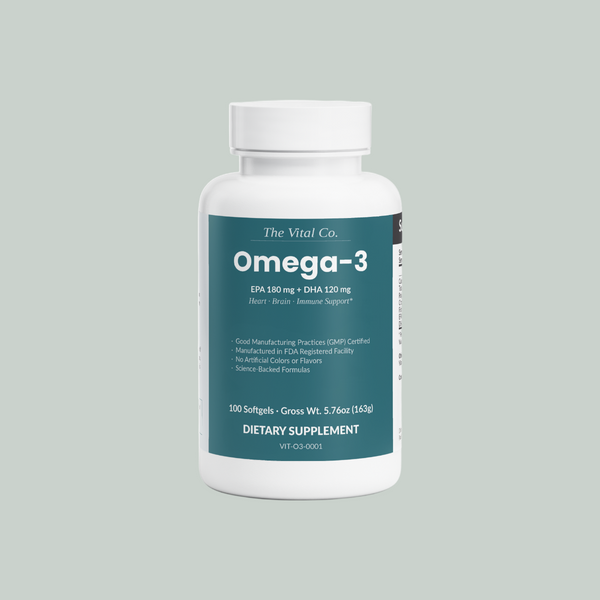
One Vital Omega-3 softgel carries 180mg of EPA and 120mg of DHA — 300mg of the two together. Against an average dietary intake of 86mg, that is not a marginal addition. It is roughly three and a half times what the average American gets from food in a day.
What EPA and DHA are doing once they are in you
Most supplement ingredients work by signalling — they bind something, switch something on, nudge a pathway. EPA and DHA are unusual in that they are largely structural. They are incorporated into the membranes of cells throughout the body, so rather than instructing a cell, they become part of it. That is also why the effect builds slowly and fades slowly: you are changing the composition of tissue, not flipping a switch.
One study makes that reversibility unusually visible. Watson and colleagues ran a randomised trial of omega-3 supplementation and measured what happened to the gut bacteria (Gut, 2018). Several genera that produce short-chain fatty acids increased — Bifidobacterium, Roseburia and Lactobacillus among them. Two other findings from the same trial belong here, because they tell you how to think about it: overall microbial diversity did not change, and the increase reversed once supplementation stopped.
One thing about that trial we should state rather than leave you to find: it used 4g a day of EPA and DHA combined, which is around thirteen of our softgels. Much of the published omega-3 research runs at intakes several times higher than a single capsule. Treat one softgel as a dietary foundation against an average intake from food of 86mg a day — or 113mg once supplements are counted — rather than as a research dose, and talk to your doctor about what level makes sense for you.
That reversibility detail is the useful one. It is an argument for taking it consistently rather than in bursts, and it is the kind of finding that tends to get left out of marketing because it implies you have to keep going.
How to take it
With a meal that contains some fat. EPA and DHA are fats themselves, and they follow the same absorption route as the fat in your food. If you are also taking turmeric, take them together — curcuminoids are fat-soluble too, and the same meal serves both.
Two things to know before you buy. Our softgel shell is gelatin, not a vegetable capsule, and the oil is from fish — so this is not a vegan product and it is not suitable for anyone with a fish allergy. If you take blood thinners, speak to your doctor first, as omega-3 can affect platelet function.
180mg EPA and 120mg DHA per softgel, from purified, molecularly distilled fish oil. Both amounts printed on the panel. Contains fish, in a gelatin softgel.
Omega-3 is also one of the three formulas in the Calm & Inflammation Stack, alongside Platinum Turmeric and Magnesium Glycinate — $72.90 for the three against $87.70 bought separately.
Calm & Inflammation Stack
Turmeric, omega-3 and magnesium. Three mechanisms, one order, $72.90.
One allergen note before you order: Platinum Turmeric contains shellfish — crab, lobster and crawfish — from its glucosamine and chondroitin.
See the stackAbout The Vital Co.
Every claim on this site has to trace back to a Supplement Facts panel or to a named published study — author, journal and year, stated where the claim is made rather than collected in a footnote nobody reads. Where a trial used a different amount than we sell, or a different group of people than you, we say so in the same sentence.
Every product at the-vital.co lists every ingredient and every amount on the panel before you buy.
FDA Disclaimer: These statements have not been evaluated by the Food and Drug Administration. These products are not intended to diagnose, treat, cure, or prevent any disease. This article is for educational purposes and is not medical advice. Consult a qualified healthcare professional before starting any supplement, particularly if you are pregnant, nursing, taking prescription medication, or managing a diagnosed condition. Individual results vary.
© 2026 The Vital Co. | the-vital.co