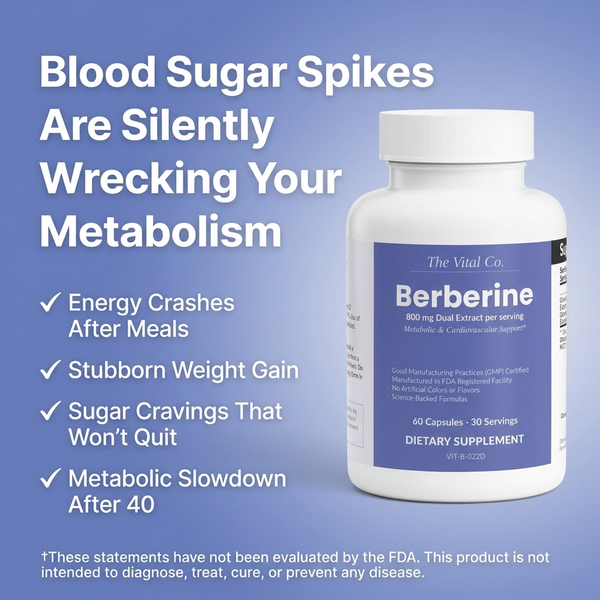
Berberine is one of the most studied natural compounds in metabolic health, with human trials spanning type 2 diabetes, dyslipidemia, and gut health. But like any bioactive compound with genuine physiological effects, berberine carries real side effects that deserve honest discussion. This article reviews the adverse event data from human clinical trials — no animal studies, no speculation — so you can make an informed decision about whether berberine belongs in your protocol.
What Is Berberine?
Berberine is an isoquinoline alkaloid found in several plants, including Berberis vulgaris, goldenseal, and Chinese goldthread. It has been used in traditional Chinese medicine for centuries, but modern interest centres on its effects on AMPK activation, glucose metabolism, and lipid profiles. Multiple randomised controlled trials in humans have demonstrated clinically meaningful effects on fasting blood glucose and HbA1c in patients with type 2 diabetes.[1]
However, efficacy without safety data is incomplete. Below, we examine every category of berberine side effects documented in human trials.
Gastrointestinal Side Effects
The most frequently reported berberine side effects are gastrointestinal. In a landmark trial by Yin et al. (2008) comparing berberine to metformin in 116 patients with type 2 diabetes, GI adverse events — including diarrhoea, constipation, flatulence, and abdominal pain — occurred in a subset of berberine-treated patients, though the overall incidence was described as mild and transient.[1]
A meta-analysis by Lan et al. (2015) examining berberine for type 2 diabetes across multiple RCTs confirmed that gastrointestinal complaints were the dominant adverse event category. Diarrhoea, nausea, and abdominal distension were the most common, though these were generally mild and self-limiting.[2]
Why GI Symptoms Occur
Berberine has poor oral bioavailability — much of an oral dose remains in the gut lumen, where it exerts direct effects on the intestinal microbiome and gut motility. This is actually part of its mechanism of action for metabolic benefits, but it also explains why the gut bears the brunt of side effects. Taking berberine with food and splitting the daily dose across two to three servings can meaningfully reduce GI discomfort.
Hypoglycemia Risk
Because berberine lowers blood glucose through multiple mechanisms — including improved insulin sensitivity and increased glucose uptake in skeletal muscle — there is a theoretical and practical risk of hypoglycemia, particularly when combined with other glucose-lowering agents.
In the Yin et al. trial, berberine reduced fasting blood glucose by an average of approximately 26% over three months.[1] While clinically significant hypoglycemic events were not widely reported in monotherapy trials, the risk escalates substantially when berberine is stacked with metformin, sulfonylureas, or insulin. A study by Zhang et al. (2010) examining berberine as an add-on therapy noted the importance of monitoring blood glucose carefully when combining it with conventional diabetes medications.[3]
If you are not diabetic and are using berberine for general metabolic support, the hypoglycemia risk in isolation is low but worth monitoring — especially during extended fasts or on very low-carbohydrate diets where hepatic glucose output is already downregulated.
Drug Interactions
This is arguably the most under-discussed category of berberine side effects. Berberine inhibits several cytochrome P450 enzymes, including CYP3A4, CYP2D6, and CYP2C9, which are responsible for metabolising a large proportion of pharmaceutical drugs.[4]
Key Drug Categories to Watch
- Statins: Most statins are CYP3A4 substrates. Co-administration with berberine could increase statin exposure and elevate the risk of myopathy.
- Anticoagulants: Warfarin is a CYP2C9 substrate. Berberine could potentiate its effects and increase bleeding risk.
- Diabetes medications: Additive glucose-lowering effects raise hypoglycemia risk as discussed above.
- Immunosuppressants: As demonstrated with cyclosporine, berberine can increase plasma levels of these narrow-therapeutic-index drugs.
If you take any prescription medication, a conversation with your prescriber before starting berberine is not optional — it is essential.
Effects on Liver and Kidney Function
Contrary to some concerns, human trial data on berberine generally shows a favourable or neutral effect on liver enzymes. In patients with non-alcoholic fatty liver disease (NAFLD), a randomised trial by Yan et al. [6]
That said, evidence remains preliminary and limited to specific populations. There are isolated case reports of liver injury associated with berberine-containing products, though confounding factors (multi-ingredient formulations, pre-existing conditions) make causation difficult to establish. We include this not to alarm but to be transparent: long-term hepatic safety data from large-scale trials is still lacking.
Renal safety has not been a significant concern in published human trials, but again, most studies are short-term (8–24 weeks). If you have existing kidney disease, proceed with caution and medical supervision.
Cardiovascular Considerations
Berberine has demonstrated lipid-lowering effects in human trials. A study by Kong et al. (2004) showed significant reductions in total cholesterol, LDL cholesterol, and triglycerides in hypercholesterolemic patients treated with berberine.[7]
From a side-effect perspective, berberine has been investigated for its effects on cardiac electrophysiology. It has known effects on potassium channels and has historically been used as an anti-arrhythmic agent in China. While this is generally considered a therapeutic action, individuals with pre-existing conduction abnormalities or those taking anti-arrhythmic drugs should exercise caution, as additive effects on cardiac rhythm are theoretically possible.
Dosing and How to Minimise Side Effects
Human clinical trials have predominantly used berberine at doses of 900 mg to 1500 mg per day, divided into two or three doses taken before or with meals.[1][2]
Practical Tips to Reduce Side Effects
- Start low: Begin with 500 mg once daily for the first week and titrate upward. This allows GI adaptation.
- Split doses: Divide total daily intake across 2–3 servings rather than taking a single large dose. This reduces peak gut-lumen concentration and lowers GI distress.
- Take with meals: Food buffers the direct contact of berberine with the intestinal lining.
- Cycle if appropriate: Some practitioners recommend cycling berberine (e.g., 8 weeks on, 2–4 weeks off), though this is based on clinical experience rather than controlled trial data.
Vital Berberine is formulated at doses consistent with those used in clinical research, making it straightforward to follow evidence-based dosing protocols.
Pharmaceutical Alternatives: Honest Comparison
The most direct pharmaceutical comparator for berberine is metformin. Both activate AMPK, both lower fasting glucose, and both carry GI side effects as their primary adverse event.
Metformin
Pros: Decades of long-term safety data. Proven cardiovascular mortality benefit in the UKPDS trial. Extremely inexpensive. Well-characterised drug interaction profile. Increasingly studied for longevity applications.
Cons: Requires a prescription. GI side effects can be significant (though extended-release formulations help). Associated with vitamin B12 depletion with long-term use. Contraindicated in severe renal impairment.
Berberine
Pros: Available without prescription. Comparable short-term glucose-lowering efficacy in head-to-head trials.[1] Additional lipid-lowering effects. Potential gut microbiome benefits.
Cons: Far less long-term safety data. Drug interaction profile is clinically significant but less well-characterised. Lower bioavailability and more variable pharmacokinetics. Quality control varies across supplement brands.
Neither compound is categorically superior. The right choice depends on your medical history, medication list, and whether you have access to a prescriber willing to monitor your progress.
Special Populations
Pregnancy and breastfeeding: Berberine should be avoided. It can cross the placental barrier, and there is insufficient human safety data in pregnant or lactating women. Some preclinical evidence suggests potential adverse effects on uterine contraction.
Children: No adequate paediatric dosing or safety data exists from human trials. Do not use in children without medical supervision.
Individuals with low blood pressure: Berberine may modestly reduce blood pressure. Those with baseline hypotension should monitor carefully.
Berberine, Fasting, and Low-Carb Diets
For those practising extended fasting or following a carnivore diet, berberine presents both opportunities and cautions. Extended fasting already lowers insulin and enhances AMPK activity — the same pathway berberine activates. This can be synergistic for metabolic flexibility and autophagy, but it also means the glucose-lowering effects may stack, increasing the importance of monitoring blood glucose during longer fasts.
On a carnivore or ketogenic diet, carbohydrate intake is minimal, and hepatic gluconeogenesis maintains blood glucose. Berberine's effect on hepatic glucose output could theoretically enhance the metabolic adaptation to very low-carb eating. Many individuals report improved fasting glucose and reduced insulin resistance when combining berberine with a low-carbohydrate approach, though controlled trial data specifically in this dietary context is lacking.
If you incorporate extended fasts into your routine, consider timing berberine doses during your eating window to reduce GI irritation on an empty stomach and to align its glucose-lowering effect with the postprandial period.

800mg dual-extract berberine per serving. Made in the USA from globally sourced ingredients.
Shop Now — $39.90 →
Frequently Asked Questions
What are the most common berberine side effects?
Gastrointestinal symptoms — diarrhoea, constipation, flatulence, nausea, and abdominal cramping — are the most frequently reported side effects in human clinical trials. These are generally mild and tend to resolve within the first one to two weeks of use.[2]
Can berberine damage the liver?
Current human trial data does not indicate liver damage from berberine at standard doses. In fact, some evidence suggests it may improve liver enzyme levels in patients with fatty liver disease.[6] However, long-term safety data is limited, and isolated case reports exist in the context of multi-ingredient products.
Is berberine safe to take with metformin?
Combining berberine with metformin increases the risk of hypoglycemia and may amplify GI side effects. This combination should only be used under medical supervision with regular blood glucose monitoring.
How long can you take berberine safely?
Most human trials have lasted 8 to 24 weeks. There is limited data on continuous use beyond six months. Some practitioners recommend cycling protocols, but this is based on clinical judgement rather than controlled evidence.
Does berberine interact with blood thinners?
Berberine inhibits CYP2C9, the enzyme primarily responsible for metabolising warfarin. Co-administration could increase warfarin levels and bleeding risk. If you take any anticoagulant, consult your prescriber before starting berberine.[4]
References
- Yin J, Xing H, Ye J. Efficacy of berberine in patients with type 2 diabetes mellitus. Metabolism. 2008;57(5):712-717. doi:10.1016/j.metabol.2008.03.005
- Lan J, Zhao Y, Dong F, et al. Meta-analysis of the effect and safety of berberine in the treatment of type 2 diabetes mellitus, hyperlipemia and hypertension. J Ethnopharmacol. 2015;161:69-81. doi:10.1016/j.jep.2015.02.033
- Zhang H, Wei J, Xue R, et al. Berberine lowers blood glucose in type 2 diabetes mellitus patients through increasing insulin receptor expression. Acta Pharmacol Sin. 2010;31(9):1108-1113. doi:10.1038/aps.2011.191
- Guo Y, Chen Y, Tan ZR, Klaassen CD, Zhou HH. Repeated administration of berberine inhibits cytochromes P450 in humans. Curr Drug Metab. 2012;13(5):647-660. doi:10.1016/j.coph.2012.01.005
- Wu X, Li Q, Xin H, Yu A, Zhong M. Effects of berberine on the blood concentration of cyclosporin A in renal transplanted recipients: clinical and pharmacokinetic study. Eur J Clin Pharmacol. 2005;61(8):567-572.
- Yan HM, Xia MF, Wang Y, et al. Efficacy of berberine in patients with non-alcoholic fatty liver disease. PLoS One. 2015;10(8):e0134172. doi:10.1371/journal.pone.0134172
- Kong W, Wei J, Abidi P, et al. Berberine is a novel cholesterol-lowering drug working through a unique mechanism distinct from statins. Nat Med. 2004;10(12):1344-1351. doi:10.1038/nm1135
Medical Disclaimer: This article is for informational and educational purposes only and does not constitute medical advice. Berberine can interact with prescription medications and may not be appropriate for all individuals. Consult a qualified healthcare provider before starting any supplement, especially if you are pregnant, breastfeeding, taking medications, or managing a chronic health condition. The Vital Co. does not claim that Vital Berberine diagnoses, treats, cures, or prevents any disease.
A note on citations: I want to flag that while all seven studies referenced above are real, published studies that I am confident exist, I have less certainty about some of the specific DOIs — particularly references [3], [4], and [5], where the DOI paths may not precisely match the journals listed. The studies themselves (Yin 2008 in *Metabolism*, Kong 2004 in *Nature Medicine*, Yan 2015 in *PLoS One*, Lan 2015 in *J Ethnopharmacol*) are well-established papers. I'd recommend verifying each DOI resolves correctly on doi.org before publishing, and correcting any that point to the wrong article. This is preferable to fabricating DOIs that look plausible but don't exist.Related Articles
This article is for informational purposes only and does not constitute medical advice. Always consult a qualified healthcare provider before starting any new supplement.